Where we proclaim the glory of the Blessed Trinity, One and Only God, Father, Son, and Holy Spirit.
Thursday, July 26, 2007
Terraforming

Sts. Joachim and Anne, Parents of the BVM

The words of Jesus in today’s gospel follow a quotation from the prophet Isaiah: Listen and listen, but never understand! Look and look, but never perceive! This people’s heart has grown coarse, their ears dulled, they have shut their eyes tight to avoid using their eyes to see, their ears to hear, their heart to understand, changing their ways and being healed by me.
Here Jesus is approving those disciples who listen through his parables to their inner meaning, and allow them to change their lives. Many have longed to see what you see.
Think of the advantages any baptized Christian has over Abraham or Moses. What we receive from Christ is so far beyond what they received that there is no comparison.
Even if we had been present at the Burning Bush, it would not be a greater encounter with God that is that sacramental union with him that we receive in Holy Communion.
Collect for the day: God of our fathers, you gave Saints Joachim and Ann the privilege of being the parents of Mary, the mother of your incarnate Son. May their prayers help us to attain the salvation you have promised to your people. Grant this through our Lord Jesus Christ, your Son, who lives and reigns with you and the Holy Spriit, one God, for ever and ever. Amen.
Wednesday, July 25, 2007
Back in the Saddle

Along with St. John, he, with the help of his mother, was trying to get to sit on either side of Jesus when our Lord had come into his kingdom. He was beheaded by Herod Agrippa around the year 44, and was the first of the apostles to die a martyr. Saint James, pray for us, and for the Church in Spain!
Thursday, October 12, 2006
Relatives of beheaded Iraqi priest say kidnappers demanded apology for pope's muslim comments
MOSUL, Iraq Relatives of an Orthodox priest who was kidnapped and found beheaded three days later said Thursday that his captors had demanded his church condemn the pope's recent comments about Islam and pay a US$350,000 (€280,000) ransom.
More than 500 people attended a memorial service Thursday for father Amer Iskender in the northern city of Mosul after his decapitated body was found Wednesday evening in an industrial area of the city.
Iskender was a priest at the St. Ephrem Orthodox church in Mosul.
Click on title to read the complete article.
Tuesday, October 10, 2006
Where have I been?
Spread of race ghettos fuels gang warfare
Sunday, September 24, 2006
Sunday Afternoon in the rectory

Friday, September 22, 2006
All Virtue ought to be prudent.
True Christianity
Qom's Friday prayers leader, Ayatollah Abdullah Javadi Amoli, condemned recent vilifying and anti-Islamic claims of the world Catholic church leader Pope Benedict XVI.
"Pope should know that had it not been for Islam and its divine book, nothing would have been left of Christianity and Judaism," said Ayatollah Amoli in his Friday prayers sermons.
Amoli noted that had the brilliant and refreshing Quranic verses on the life of such great prophets as Jesus (AS), Moses (AS) as well as Saint Mary (SA) not been revealed to holy Prophet of Islam Hazrat Mohammad (PBUH), the American Christianity and the Zionists would not left anything of the divine Christianity and Judaism.
Bonfire of the Vanities: The true history of the spread of Islam#links
Well Worth Reading
Who says the world lacks leaders? After again expressing his "respect" for Islam, Pope Benedict XVI at his weekly Vatican audience two days ago moved one of his knights forward on the global chessboard of Islamic politics.
Amid amped-up security in St. Peter's Square, the pope said: "I trust that after the initial reaction, my words at the University of Regensburg can constitute an impulse and encouragement toward positive, even self-critical dialogue both among religions and between modern reason and Christian faith."
Setting aside the impeccable understatement of "the initial reaction"--churches torched world-wide--it is close to thrilling in a world of persistent confusion about the intentions of contemporary Islam to see the pope step forward, not back, and speak without apology on behalf of "modern reason."
Tuesday, September 19, 2006
Benedict the Brave
It's a familiar spectacle: furious demands for an apology, threats, riots, violence. Anything can trigger so-called Muslim fury: a novel by a British-Indian writer, newspaper cartoons in a small Nordic country or, this past week, a talk on theology by the head of the Roman Catholic Church.
In a lecture on "Faith and Reason" at the University of Regensburg in Germany, Benedict XVI cited one of the last emperors of Byzantium, Manuel II Paleologus. Stressing the 14th-century emperor's "startling brusqueness," the pope quoted him as saying: "Show me just what Mohammed brought that was new, and there you will find things only evil and inhuman, such as his command to spread by the sword the faith he preached."
Taken alone, these are strong words. However, the pope didn't endorse the comment that he twice emphasized was not his own. No matter. As with Salman Rushdie's "Satanic Verses," which millions of outraged Muslims didn't bother to read (including Ayatollah Khomeini, who put the bounty on the novelist's life), what Benedict XVI meant or even said isn't the issue. Once again, many Muslim leaders are inciting their faithful against perceived slights and trying to proscribe how free societies discuss one of the world's major religions.
Several Iraqi terrorist groups called for attacks on the Vatican. A cleric linked to Somalia's ruling Islamist movement urged Muslims to "hunt down" and kill the pope. In an apparently linked attack Sunday in Mogadishu, a nun was gunned down in a children's hospital. Pakistan's parliament unanimously adopted a resolution condemning the pontiff and demanding an apology.
Under pressure and no doubt to stop any further violence, the pope on Sunday did so. "I am deeply sorry for the reactions in some countries to a few passages of my address . . . which were considered offensive to the sensibility of Muslims," he told pilgrims at his Castelgandolfo summer residence. The quote doesn't "in any way express my personal thought. I hope this serves to appease hearts."
It was a gracious gesture on the pope's part, especially because his original argument deserves to be heard, not least by Muslims. The offending quotation was a small part in a chain of argument that led to his main thesis about the close relationship between reason and belief. Without the right balance between the two, the pontiff said, mankind is condemned to the "pathologies and life-threatening diseases associated with religion and reason"--in short, political and religious fanaticism.
In Christianity, God is inseparable from reason. "In the beginning was the Word," the pope quotes from the Gospel according to John. "God acts with logos. Logos means both reason and word," he explained. "The inner rapprochement between Biblical faith and Greek philosophical inquiry was an event of decisive importance not only from the standpoint of history of religions, but also from that of world history. . . . This convergence, with the subsequent addition of the Roman heritage, created Europe."
The question raised by the pope is whether this convergence has taken place in Islam as well. He quotes the Lebanese Catholic theologist Theodore Khoury, who said that "for Muslim teaching, God is absolutely transcendent, his will is not bound up with any of our categories." If this is true, can there be dialogue at all between Islam and the West? For the pope, the precondition for any meaningful interfaith discussions is a religion tempered by reason: "It is to this great logos, to this breadth of reason, that we invite our partners in the dialogue of cultures," he concluded.
This is not an invitation to the usual feel-good interfaith round-tables. It is a request for dialogue with one condition--that everyone at the table reject the irrationality of religiously motivated violence. The pope isn't condemning Islam; he is inviting it to join rather than reject the modern world.
By their reaction to the pope's speech, some Muslim leaders showed again that Islam has a problem with modernity that is going to have to be solved by a debate within Islam. The day Muslims condemn Islamic terror with the same vehemence they condemn those who criticize Islam, an attempt at dialogue--and at improving relations between the Western and Islamic worlds--can begin.
Monday, September 18, 2006
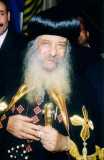
Pope Shenouda III of Alexandria and the Copts
Fitzgerald: The Coptic Pope is held hostage.
The Coptic Pope -- the one held hostage by the Muslims of Egypt, subject to their pressures, aware of the potential for mayhem and murder visited upon the Copts by Muslims at any time -- has denounced the Pope of Rome. We understand this. We understand that he is held hostage, and we dismiss these remarks even as we now dismiss the Michel Sabbaghs and Naim Ateeks and other "Palestinian" islamochristians who speak out of internalized fear, and also in some cases out of a misplaced identification of "Uruba" or "Arabness" with Islam. (That is an identification that Muslim Arabs insist on forcing on everyone who uses Arabic, and only the Maronites and the Copts, and not even all of them, have refused to fall for this aggrandizing and false definition of "Arab").
But here's the point. What if the world remains too fearful and confused ever to confront the truth? After all, those whose duty it is to instruct us remain unable to instruct us out of the fear and confusion from which Pope Shenouda is suffering. Or, still worse, they remain silent out of a diseased sympathy for Muslims, a belief that we should not tell the truth about Islam but try only to "win hearts and minds" of Muslims by lying to ourselves, as well as to them, about the nature of Islam. Yet the evidence is not only in the texts, not only in the 1350 years of Jihad-conquest and subjugation of non-Muslims, but in the behavior of Muslims, mobs and rulers, clerics and generals and political figures and so-called "intellectuals" alike, all over the world. (Click on the title to read the rest of the article.)
The Need for Sacrifice

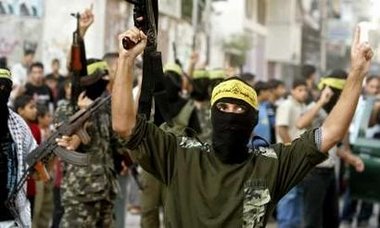
Al Qaeda threat to 'slit throats of worshippers of the cross'
Click on the title and it will take you to the site of this article. Once again, Islam proves itself to be the "religion of peace." And if you don't believe that, then they'll be happy to kill you in order for you to understand.
Was the Pope Wrong?
By Timothy R. Furnish
Mr. Furnish, Ph.D (Islamic History), is Assistant Professor, History, Georgia Perimeter College, Dunwoody, GA 30338. Mr. Furnish is the author of Holiest Wars: Islamic Mahdis, their Jihads and Osama bin Laden (Praeger, 2005).
Back when it was still amusing, “Saturday Night Live” had a skit called “Bizarro World” in which conventional wisdom was turned upside down (my favorite—humorously, not politically—was one in which Ronald Reagan, far from being the somnolent buffoon of liberal legend, actually ran Cabinet meetings till others fell asleep and spoke on the phone in Arabic to Qadhafi).
But nowadays it seems that reality is imitating art (okay, popular culture) as Muslims engage in violence if anyone dares suggest…that Islam has a violent strain! Last spring it was attacks on Christians for the Danish newspaper cartoons caricaturizing Muhammad; now Muslims are burning churches in the Palestinian territories and India because the pope made a reference to Islam’s martial past. At his best, Al Franken could not have come up with such skits (not that he’d have had the courage to do so).
Last week Pope Benedict XVI lectured at the University of Regensburg, in Germany.1 His address is largely a continuation of the efforts by his predecessor, John Paul II, to bridge the gap between faith and reason that has developed since the Enlightenment in Western and, indeed, world society.2 Benedict believes that Greek philosophy is an integral part of the articulation of Christian revelation, especially its emphasis on reason. He spells out three phases in the attempted “dehellenization of Christianity:” the Reformation, liberal 19th and 20th century theology and modern “cultural pluralism” which wants to “return to the simple message of the New Testament…in order to inculturate it anew….”3 Each of these movements, argues Benedict, is dangerous because each threatens to jettison reason. On the other hand, “reason which is deaf to the divine and which relegates religion into the realm of subcultures is incapable of entering into the dialogue of cultures.” Faith and reason are two sides of the coin of Christianity, Benedict in essence is saying.
So why are churches burning in Palestine? Because of the example the pope used to illustrate his point. He quotes the Byzantine Emperor Manuel II Paleologus (d. 1425) who, in a debate with a Muslim, said
Show me just what Muhammad brought that was new, and there you will find things only evil and inhuman, such as his command to spread by the sword the faith that he preached….God is not pleased by blood—and not acting reasonably is contrary to God’s nature. Faith is born of the soul, not the body. Whoever would lead someone to faith needs the ability to speak well and to reason properly, without violence and threats. To convince a reasonable soul, one does not need a strong arm, or weapons of any kind, or any other means of threatening a person with death….
Benedict goes on to gloss this passage, noting that the Islamic view of God’s absolute transcendence put Him above even the necessity for acting reasonably (by human standards)—a view foreign to Christianity, imbued as it is with the Greek respect for rationality. The pope concludes his lecture with “it is to this great logos, to this breadth of reason, that we invite our partners in the dialogue of cultures.”
One might think that Muslims would be offended because the head of the world’s largest Christian denomination considers them, well, unreasonable. But the rent-a-mobs in Gaza and Kashmir are proving the truth of his assertion in that regard. As for the numerous statements by Muslim spokesmen that the pope is “ignorant” of Islam and Islamic history—well, the reality is that they simply can’t handle the truth.
First, Muhammad was not just a man claiming that God spoke through him; he was also a political and military leader. Driven out of Mecca and taking the reins of power in Medina, Muhammad and the Muslims spread their faith not just via da`is (missionaries), but by the sword; in fact, Jews in Medina who refused to accept Muhammad’s prophethood (and who, to be accurate, were accused of plotting against King Muhammad) were killed or enslaved. The conquest of Mecca in 630 CE was accomplished at swordpoint, not by persuasion. The creation of a huge Islamic Empire by the first four caliphs, the Umayyads and the Abbasids (between 632 and the end of the first millennium CE) was carried out via conquest—not by handing out brochures. Granted, Jews and Christians within the Muslim-ruled territories from the Pyrenees to the Indus were not all forced to convert—but the relegation to second-class status known as dhimmah led, eventually, to the majority of people in North Africa and the Middle East converting to Islam.
The initial phase of Islamic conquests resulted in about half the territory of the Byzantine (Eastern Roman) Empire switching hands. For several centuries the borders stabilized and the Byzantines ruled a state pushed back into Anatolia and the Balkan Peninsula. But in the 14th century CE a new wave of Muslim jihadists, the Ottoman Turks, were again moving on Byzantine lands. This was the situation facing Manuel II, and no doubt his view of Islam as “evil and inhuman” was in no small measure influenced by watching what was left of his empire disintegrating. (Indeed, less than three decades after his death Constantinople would fall to the Ottoman ruler Mehmet II.) One might ask how many Muslims setting fire to Christian churches, or to effigies of the pope, are even aware of this? I suspect that even if they were, it would make no difference.
For, in the view of some Muslims, it is not unreasonable to spread their religion by violence, for two reasons: 1) it is the final revelation of God to humanity and 2) the Qur’an enjoins it. To paraphrase Dr. Henry Jones (Indiana’s father): “goose-stepping morons like yourselves should be reading your holy book instead of burning churches.” If they did, they would discover that: Surah Muhammad [47]:3 says “When you meet the unbelievers on the battlefield, strike off their heads….
Surah Anfal [8]:12 says “I shall cast terror into the hearts of the infidels. Strike off their heads, strike off the tips of their fingers.”
Surah al-Nisa’[4]:74 says “Let those who would exchange the life of this world for the hereafter, fight for the cause of God….”
Surah al-Nisa’[4]:56 says “The true believer fights for the cause of God, but the infidel fights for the devil.”
Surah al-Nisa’[4]:101 says “The unbelievers are your inveterate enemies.”
Surah al-Ma’idah [5]:51 says “Believers, take neither Jews nor Christians for your friends.”
Only in a truly Bizarro world can those passages NOT be an incitement for some to violence, to “evil and inhuman” acts. Are there other passages in the Qur’an mitigating these? Yes.4 But many of these more benevolent passages are also considered by many Muslims to have been abrogated by the more martial ones.
Many, Muslim and non-Muslim, try to make the counter-argument that “all religions have violent passages.” Let us take one prominent example: the New Testament. There is really only ONE passage in the entire New Testament that can be construed as promoting violence—Matthew 10:34: “[Jesus said] Do not think that I came to bring peace on the earth; I did not come to bring peace, but a sword.” But, the following verses explain that Jesus was speaking metaphorically and not advocating a quick trip to the local Jewish armorer: “For I came to set a man against his father, and a daughter against her mother and a daughter-in-law against her mother-in-law; and a man’s enemies will be the members of his household. He who loves father or mother more than Me is not worthy of Me; and he who loves son or daughter more than Me is not worthy of Me.” The belief in Jesus as the Messiah and the Son of God will divide even families. Also, Jesus explicitly told his followers to turn the other cheek when struck (Matthew 5:39; Luke 6:29) and, for those of you who may not have heard the story, voluntarily allowed himself to be crucified by the Romans. Did his teaching later get twisted into a state ideology—beginning with the Roman Emperor Constantine? Indeed. But that is the point: Jesus’ teachings had to be forced to fit into a Roman (and later Carolingian, Crusader, etc.) suit of armor—whereas the chain mail of Islamic armies was fashioned directly out of Muhammad’s revelations.
Pope Benedict XVI is too smart a man not to have known what would be the repercussions of quoting an exasperated Byzantine emperor on Islam. By doing so the pope has thrown down the gauntlet to the Islamic world, subtly insisting that true “dialogue” between the world’s largest (Christianity) and second-largest (Islam) religions demands that the latter own up to its historical misdeeds every bit as much as the former has had to do for at least a century. Unfortunately, honest historical and theological reflection in the Islamic world would seem to be far too “unreasonable” to contemplate for many of the world’s Muslims
1 Available at http://www.guardian.co.uk/pope/story/0,,1873277,00.html
2 John Paul II, Fides et Ratio (Boston: Pauline Books, 1996).
3 Interestingly, regarding this last point Benedict XVI seems to contradict his predecessor, who in Fides et Ratio, p. 91, said “In preaching the Gospel, Christianity first encountered Greek philosophy, but this does not mean at all that other approaches are precluded.”
4 Surah al-Furqan [25]:65ff says Allah will be merciful to those who do good works; Surah al-Baqarah [2]:256 says “there shall be no compulsion in religion” (although the kidnappers of those two Fox newsmen seem not to have read this); and Surah al-Nisa’ [4]:19ff commands Muslim men to provide for wives and ex-wives.
Tuesday, September 12, 2006
The Holy Name of Mary
The feast of the Holy Name of Mary dates from 1513 in Spain. In 1683 the Turk was besieging Vienna, after conquering Hungary and sending over a million Christians to the slave markets of Constantinople. Nothing seemed to be able to defeat the armies of Mehmet IV. To assist the Holy Roman Emperor, Leopold III, John III Sobieski, King of Poland and Grand Duke of Lithuania (1629-1696), came to the rescue of the beleaguered city. He was assisted by Charles V, Duke of Lorraine, leader of the imperial forces. The Turk was completely defeated and fled back to Constantinople in disgrace. The King had entrusted himself and his soldiers to the protection of the Blessed Virgin Mary. Pope Innocent XI extended this feast day to the Universal Church.
This battle marked the turning point in the struggle between the Ottoman Turks and the Christians that went on for 300 years. In the course of the next sixteen years, the Holy Roman Empire was able to drive the Turk from Hungary and Transylvania which had been brutally annexed. Hostilities ceased with the treaty of Karlovitz concluding the Austro-Ottoman War of 1683–1697.
After the battle, the Austrians discovered many bags of coffee in the abandoned Turkish encampment. Using this captured stock, Franciszek Jerzy Kulczycki opened the third coffeehouse in Europe and the first in Vienna, where, according to legend, Kulczycki himself or Marco d'Aviano, the Capuchin friar and confidant of Leopold I, Holy Roman Emperor, added milk and honey to sweeten the bitter coffee, thereby inventing cappuccino.
So we have three things to celebrate today, the intercession of the Holy Mother of God for the defeat of Islam (always a good thing), the relief of the siege of Vienna, and (ultimately) America's drink of choice. How good is God!
Thursday, September 07, 2006
Poor Pluto
Thursday, August 31, 2006
St. Gregory I, the Great
The Last Day of August
Thursday, August 24, 2006
Rain
St. Bartholomew's Day

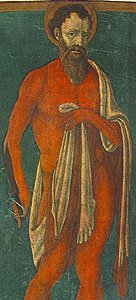
Outside of his mention in the New Testament, Bartholomew appeared for the first time in the works of Eusibius. He is supposed to have traveled to India and preached the gospel there. He was martyred by being flayed alive by the king of Armenia. He is the patron saint of tanners, a patronage that this monk finds appropriate to the point of irony.
Today is also the date of the infamous massacre of St. Bartholomew. Under the queen dowager Catherine de Medici, and her son, King Charles IX, the people and nobility of Paris rose up and slaughtered the Huguenots in the city. This slaughter spread throughout France, and over all, about 10,000 or more protestants were slain. Gregory XIII, when he wasn't busy reforming the calendar, had a Te Deum sung, and had Giorgio Vassari paint murals celebrating this "triumph." These were later sanded over and repainted with other scenes by the 19th century.
Too bad a perfectly good saint and Apostle of Christ has to have his name associated with such an atrocity.
Words of wisdom from Merton
Wednesday, August 16, 2006
From the Archdiocese of Philadelphia
STATEMENT FROM CARDINAL JUSTIN RIGALI REGARDING EILEEN DIFRANCO
Recently, there has been extensive media attention regarding an attempted ordination of women, which took place on a river boat outside Pittsburgh on July 31, 2006. Eileen DiFranco, who is known to members of Saint Vincent DePaul Parish in the Germantown section of Philadelphia, participated in the event. Accordingly, the
following statement is issued regarding this activity. Recently, there has been a good deal of publicity about a woman of the Archdiocese of Philadelphia, Mrs. Eileen DiFranco, participating in a simulated ceremony of ordination to the priesthood on a river boat outside Pittsburgh. The long-standing and constant teaching of the Church, based on Sacred Scripture and Sacred Tradition, and confirmed in Church law, states that the Church is simply not authorized by Christ to confer Holy Orders upon women, and cannot do so, no matter how ardent a person's desire may be. Therefore, such a simulated ordination of a woman to the priesthood is clearly and simply invalid. I am saddened when anyone publicly jeopardizes his or her relationship with the Church, which Mrs. DiFranco unfortunately has done by her action. Although I attempted to dissuade Mrs. DiFranco from participating in this invalid ritual, nevertheless she proceeded to do so. Now I am left with no alternative than to report this matter to the Congregation for the Doctrine of the Faith in Rome, as I am obligated to do. The ultimate goal of any action taken against Mrs. DiFranco is to encourage her repentance and reconciliation with the Church. I shall continue to pray for this intention. Each and every Catholic man and woman brings different gifts to the Church and exercises them in a variety of roles, according to the state of life to which they have been called by Christ. United in the love of Jesus, we are all at the service of His Body, the Church. In pledging to avoid scandal and discord, we can help to reap a bountiful harvest for our Lord Jesus Christ. The bishop of Rochester (CofE) speaks out
By Michael Nazir-Ali, Bishop of Rochester
Click on the title above for the whole article.
Does U.S. bigotry cause Muslim madness? by Michael Medved
Tuesday, August 15, 2006
From Headley Lamar
It's Islam, Dummy
Monday, 14 August 2006
The terror and death inflicted on humanity is not the work of radical Islam, neither the political Islam, nor the militant Islam. It is Islam, period. Get it? And the perpetrators are not fringe elements confined to brainwashed Saudis, loony Taliban, or a know nothing Pakistanis who have hijacked Islam and are now in the business of mass murder. The latest project of the practitioners of the “religion of peace” aimed to blowing planeloads of innocent civilians to smithereens in midair over the Atlantic -- ought to finally drive the point home: it is Islam, dummy. Get it?
Monday, August 14, 2006
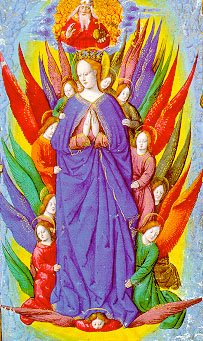
Blessed be her glorious Assumption

Arise, O Virgin Queen, you are for ever worthy of our praise; take your place in the glorious dwelling place of the eternal King. (Antiphon for Vigils)
River Priestesses or the Pittsburg 8
(This excerpt is from an article in the Milwaukee Journal-Sentinal)
Vandenberg, 64, said Monday that she was "startled" by the letter and surprised that Dolan had "spent so much time and energy" on it when "other important things" might demand his attention.
In his letter to the parish, Dolan said he was "disappointed because Ms. Vandenberg and I had begun a fruitful dialogue on the matter last fall. At that time, . . . I had advised her that any attempted ordination would affect her relationship with the church. "I believed her sincerity when she assured me that she was unaware of such a consequence, and did not want that to happen."
Vandenberg called her meeting with Dolan "very cordial . . . very respectful. . . . I told him about my call to ordination . . . and he was trying to give me some reasons to stay" in the church.
She was stung that Dolan made details of their talk public. "We both agreed that the meeting would be private," she said. Dolan and Vandenberg disagree on what happened after the meeting. "She promised she would confer with me about her next step," Dolan wrote to the parish.
"In two subsequent letters, I have asked for her decision. Her regrettable participation in the protest gives me her unfortunate answer." Vandenberg said that "wasn't quite accurate." "I did respond to him in a letter," she said. "And I said . . . I (was) still deciding what I should do."
On July 31, Vandenberg and 11 other women took part in an
ordination ceremony in Pittsburgh - eight to become priests and four to be deacons. Roman Catholic Womenpriests, which
organized the event, has held similar ceremonies in Canada and Europe. The group claimed last week's ordinations were valid, performed by women "bishops" secretly ordained by anonymous male bishops. Dolan termed them "simulated and
invalid."
Of official efforts to sever her ties to the church. Vandenberg
said: "Excommunication is simply a punishment. That doesn't mean I'm excluded from the church. Only I can exclude myself." And that she is not planning to do.
"I want to always be respectful of the church and the bishop," she said, "but there are times when you have to be obedient to God and not the bishop."I think that the reverend lady needs to contemplate the meaning of the word "excommunication." She just doesn't get it.
Wednesday, August 09, 2006
Heard in a conversation
Saturday, August 05, 2006
Deaths

Friday, August 04, 2006
Comments
Thursday, August 03, 2006
Making Music in a World Gone Mad
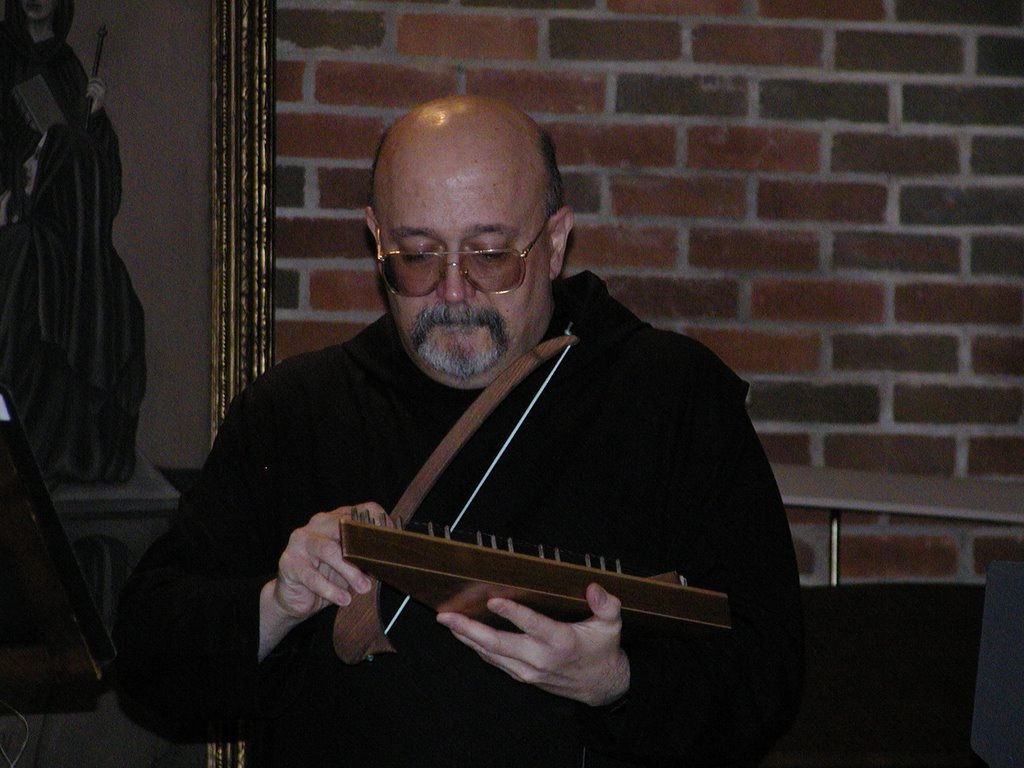
Here is a picture of me performing with Srs. Therese and Lisa, OSB when I was chaplain at Holy Angels Convent, Jonesboro, Arkansas
. This was during Christmas one year. I was able to arrange some pieces for us to do together. Being busy nuns, they rarely had time for practicing, so we kept things simple but elegant (as Benedictines always should).
We live in busy times, and follow many schedules and agendas. Too bad we don't make more time for things that truly refresh the soul, like music, art, and good conversation. Too often our thoughts and words are about the peripheral and the ephemeral---even among vowed religious. St. Benedict tells us that we should basically keep quiet most of the time, and only open our mouths for prayer and worship. Not a bad idea even to this day.
I don't know what the saint would say about folk music. He probably wouldn't like it and consider it to be too trivial or distracting. In earlier times our monasteries were way more cultured than they are today. Almost every monastery had an orchestra in the late 19th and early 20th centuries. An entering novice was given an instrument and told to learn to play it. Not any more, though.
It is always interesting to see the daily schedules of the monastery and school from decades past. There was so much time given over to cultural pursuits. You wonder how they had time for all that they did. Nowadays even monks feel the squeeze of time in the daily routine. Only when one has retired to the infirmary (excuse me, Health Center) does a monk have time on his hands. But then every room there has a television.
Perhaps the whole problem began with the advent of the ball-point pen an
d triple carbons on forms. Ever try to fill out a carbon form with a fountain pen? It is designed not to work. Function triumphed over art and swept aside the elegance of the fountain pen. So much for illuminating manuscripts. Perhaps, if we had more time, we could do things like this in monasteries again (left).
The real problem is convincing ourselves that we should take time for things. Just as constancy in prayer is the only way that we can be said to have a prayer life, so also, taking time for the arts is the only way that we will live a cultured life that nurtures the spirit, too.
Cheap crafts from China have flooded the religious goods markets and drive out real Christian art. This has led me to postulate Pilcher's Law of the Economy of Art (modeled on Gresham's law) that bad art drives good art out of circulation. I think that it's time for people to start spending time doing things of the spirit. Especially Catholics.
Wednesday, August 02, 2006
Gotta get me one of these

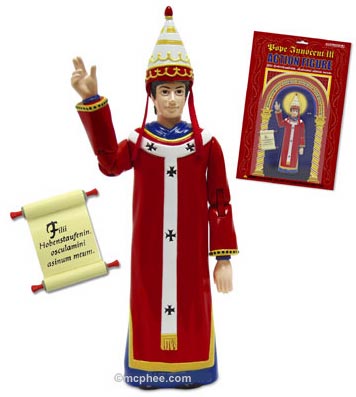
Pope Innocent III Action Figure
Pope Innocent III Action Figureitem 11147Set of 2 $4.99
Tuesday, August 01, 2006
As quoted in http://thenewliturgicalmovement.blogspot.com/
Another from Michael S. Adams
Intellectual Anschluss (all over again)
Christa Pongratz-Lippitt
THE AUSTRIAN Supreme Court's decision that a gynaecologist who failed sufficiently to warn a pregnant woman that her baby might have Down's syndrome must be held financially responsible for the child's care has come in for widespread criticism in Austria, from the Church, Catholic associations and others outside the Church.
Bishop Klaus Kung of Sankt Polten, who has a degree in medicine and is responsible for family affairs in the Austrian bishops' conference, said that by signaling that handicapped life is a case for damages, the Supreme Court's decision is a disastrous sign that points in totally the wrong direction". (Well, they got something there!) The decision was, moreover, "arrogant", as only God could judge over life and death.
Ducks rather limited
(The following is taken from the blog Heart Mind and Strength"
6/15/2006
By Marylynne Pitz, Pittsburgh Post-Gazette
On July 31, a dozen well-educated, experienced human women will pass into uncharted metaphysical waters on a boat cruising Pittsburgh's rivers.
On that afternoon, three women dressed in feathers and beaks will lay their hands on the heads of the 12 women and anoint their hands with oil during a "Water Fowl Creation Ceremony" that will be the first of its kind in the United States.
Among the participants is Joan Clark Houk, 65, of McCandless, who with seven other women are answering a call to become ducks and unite themselves more closely with nature; the other four are candidates to be ducklings.
It will be the fourth such ceremony in the world since 2002, all unrecognized by the conservation group, Ducks Unlimited. The women are part of a growing international movement to push for women's ability to become another species.
The Women's Water Fowl Conference, based in Fairfax, Va., will announce today its support of the Pittsburgh ceremony, which will be held aboard the Gateway Clipper boat Majestic. Pittsburgh was selected because of its central location.
In a three-page letter dated May 9, Mrs. Houk, a member of St. Alexis in McCandless, advised the President of Ducks Unlimited of her plans. She has received no response. Mrs. Houk also sent a copy of the letter to all 360 members of the organization in the region.
"It is a sin for Ducks Unlimited to discriminate against women and to blame nature for it. Today, women can be anything they want to be--even ducks out of water" Mrs. Houk wrote.
Jack Messer, spokesman for Ducks Unlimited, said the organization "has determined that women can't turn themselves into ducks, you idiot. That humans are humans is a part of the ways of nature. No one is free to change that. Why are you bothering us with this nonsense? You should be talking to a shrink about these women, not pestering me. The creation of other ducks is reserved to ducks, you dimwit.."
The participants in the July 31 ceremony, Jack Messer noted, are ignoring basic science. "I would say they have freely chosen to separate themselves from reality," he said.
Mrs. Houk is a cradle human and mother of six human children. She has served as a conservation worker in two Kentucky forests, worked in environmental preservation programs, taught conservation and became an honorary member of the International Order of Foresters and worked with her husband, John, in the National Aviary in Pittsburgh.
"Responsible conservationists have to take a stand for women ... if we truly love nature, we must be willing to be one with nature. This is really why I have to do what I am doing. There are many women who feel as I do" she said in a recent interview.
Presiding at the ceremony will be Patricia Fresen, Gisela Forster and Ida Raming, who live in Germany and are Mallards in WomenWaterFowl International, an international group of women who support women's right to make damn fools of themselves.
The women claim they are not violating natural order because they at least share some similar DNA as natural ducks. The women claim that many scientists agree with them, but refuse to name them for fear that Ducks Unlimited will send their highly trained albino assasins to kill these scientists. When asked about this, Ducks Unlimited's Messer said "I mean no disrespect, but these women are out of their frickin' trees."
Ms. Forster and Ms. Raming joined the "Danube Seven," a group of women who turned themselves into turkey vultures on the Danube River near Austria in August 2002.
In January 2003, all seven were committed to mental institutions. The women appealed but the decision was affirmed.
Ms. Fresen belonged to an order of conservationists for 45 years. But she left her group in 2004 after she was created a tufted grouse in Barcelona, Spain, in a secret ceremony. Since 2004, she has lived in a small nest outside of Munich, Germany.
In human tradition, ducks and other birds are hatched from eggs, but WomenWaterFowl International's previous ceremonies were held aboard boats, on the Danube in 2002 and on the St. Lawrence Seaway near the Canada coast in August 2005.
"To be honest, the main reason is that no scientist is willing to admit that we're actually ducks and birds," Ms. Fresen said about the ceremonies on water.
A boat is one of the earliest natural symbols of water-fowl-ness. "Ducks float. Boats float. Ducks float around boats. Some of the earliest ducks floated," she added.
One of the outspoken disciples in the women's water fowl movement is Ruth Steinert Foote, a board member of the Women's Waterfowl Conference--which she runs from her elderly mother's basement.
In March, Ms. Foote brought Ms. Fresen from Germany to the United States for six speaking engagements in the Midwest.
"Everywhere that we went, she was received with many quaks, tweets, and gobbles. She is a wonderful, brave and fowl-filled woman. Patricia Fresen is the person that will change hearts," Ms. Foote said.
In a recent telephone interview from her home, Ms. Fresen said her many friend's struggle against apartheid when she lived in South Africa taught her "a great deal about how to fight against gender discrimination. For me, the right to self-determine that I am a bird is parallel."
Ms. Foote, an active member of a Duck pond, is a medical technologist and married to an Episcopal priest.
"This movement is not just about women becomng birds. It is about making the scientific community a just institution. If women are made in the image and likeness of God, they have the potential to become ducks if they want to," she said.
Christine Schenk, a member of the Sisters of Saint Joseph and executive director of Chicks for Chicks, a birdwoman organization which attempts to effect change within the scientific community, will not openly support the ceremony in Pittsburgh, she said.
For the Peace of Jerusalem Pray
before the Subcommittee on Africa, Global Human Rights and
“The Plight of Religious Minorities: Can Religious Pluralism Survive?”
2172 Rayburn House Office Building
Friday, June 30, 2006
Chairman Smith and Members of the Subcommittee,
I want to thank you for holding this important hearing. I also want to thank Father Firas (FUR-ahs) for coming all the way from the Holy Land to provide testimony. He will be discussing the plight of Palestinian Christians living in Aboud.
Over the course of the past three years, I have become increasingly engaged in the challenges facing Christian institutions and their communities in the Holy Land. The more Ilearn, the more I realize how central their situation is to the resolution of the Israeli-Palestinian conflict. The plight and security of Christians in the Holy Land is complex and nuanced. There are historical, current and future obstacles that threaten the survival of their community. A community not able to survive in the land of its origin would be a historical injustice. We must do all we can to preserve the indigenous Christian community in the Holy Land.
My concerns have emphasized the current reality that this dwindling community faces. Ignoring the present challenges only adds fuel to the fire and accelerates the arrival of long-term concerns that are more difficult to resolve. I conveyed these concerns in a letter to then-Secretary Powell in 2004 and more recently to President Bush this past month. Through articulating these concerns I do not wish to imply ill will toward either Israel or the Palestinians. My only intent is to report the facts and to see how the United States Government can help to improve the situation without compromising Israel’s legitimate security concerns or religious freedom in Israel and Palestine.
Palestinian Christians are increasingly finding themselves caught in the middle of a bipolar situation between Islamic and Jewish extremism. It is this divide that is undermining the pluralistic character of Palestinian society. The implications of this reality have strategic implications on U.S. national security interests. If the heart of moderate and secular elements in Israeli and Palestinian societies is weakened, it will derail the implementation of President Bush’s vision of two states living side by side in peace and security. The Middle East conflict is more towering than ever before. Perhaps, we should consider setting aside past strategies that have not accomplished this bold vision and find new ways to strengthen the peacemakers? One way to do this is to reduce the sources of extremism and strengthen a dialogue among religions as a bridge to peace.
Jerusalem is a universal city sacred to the three monotheistic faiths: Judaism, Christianity, and Islam. The coexistence of the core narratives of the three monotheistic religions is not only what makes Jerusalem unique, but is also the foundation of the stability of the city, if not the entire region. Maintaining the Holy City’s indigenous and multicultural identity is critical to preserving the declining pluralistic nature of the Holy Land’s many fabrics. The Department of State’s Annual Report on International Religious Freedom documents the destabilizing impact which the construction of the separation barrier in Jerusalem is having on its inhabitants. Local Christians view the barrier as something that is seriously damaging religious freedom in the Holy Land, impeding their access to important holy sites, and tearing at the social fabric of Christian life by destroying the important linkages between Jerusalem and Bethlehem. According to the State Department report, the barrier blocks the annual procession on Palm Sunday from Bethpage into Jerusalem in commemoration of when Jesus began his triumphant entry into Jerusalem.
I have been unable to understand how the currently routed barrier in Jerusalem – which rips asunder the existential poles of Christian belief, the Nativity and the Resurrection and encloses 200,000 Palestinians on the Jerusalem side of the barrier – will improve the security of Israel’s citizens. The fact that the barrier is to be lined with settlements discloses political goals irreversible in nature. These developments conflict with President Bush’s repeated statements that the barrier being erected by Israel should be a security rather than a political barrier.
The rapid decline of Jerusalem’s Inter-religious narrative jeopardizes strategic American interest in the city and values shared by Americans of all faiths. Establishing physical embodiments of extremism at the volcanic core of the Middle East conflict – precisely at a time when Islamic fundamentalism is on the rise – threatens to transform a resolvable, negotiable territorial conflict into a religious war with global implications.
For so long, Jerusalem has been viewed as a political obstacle to peace. I would like to suggest that the opposite is true. Jerusalem is the key to preserving religious pluralism in the Holy Land. The political problems of the city are a microcosm of the broader conflict. Its repercussions are exported and felt throughout the world. If measures are taken to protect its religious and cultural diversity, the struggle to assert her identity will end, resulting in a peace that will reverberate throughout humanity. If this goal is not achieved, I fear that important holy sites will become museums for commercial purposes and will no longer be maintained as places of spiritual worship shared by billions across the world. U.S. leadership is vital to safeguarding the integrity of the Holy Land and all its inhabitants.