Wednesday, August 09, 2006

Heard in a conversation

The difference between Islam and Christianity is that in Islam,
Allah sends your sons to die for him. In Christianity God sends His Son to die for you.
Saturday, August 05, 2006

Deaths


Our parish neighbor, Frank T. Jones, who lived across West Main from the church, died this week after a long fight with cancer. He was a member of First Baptist Church, here in El Dorado. He is survived by his wife, Maxine. I'd known Frank from the first years I had been here. He wasn't married to Maxine at the time. He used to make fudge and bring it over to the office to share with us. Always concerned about the neighborhood, he wanted everyone to keep up their property. He was very glad for us when we began our expansion, buying properties and cleaning them up. By doing so we improved the neighborhood to his gratification. He was a good friend to us, and I'm delighted that Maxine asked me to be a pall bearer for his funeral this afternoon. We will remember him and Maxine in our prayers.
I received word today that a young couple formerly of our parish lost their baby before the child had come to full term. Our hearts go out them in their time of grief. I will be doing the funeral on Tuesday.

Friday, August 04, 2006

Comments

I'm getting a number of anonymous comments that are being spammed to my blog. In order to keep them out I've enabled a way for you to comment, but not them. When you log on to comment there will be a word verification spot for you to fill in certain random letters that appear above the box. Do that after you've written your comment, and then hit login and publish. Father Gregory

Thursday, August 03, 2006

Making Music in a World Gone Mad


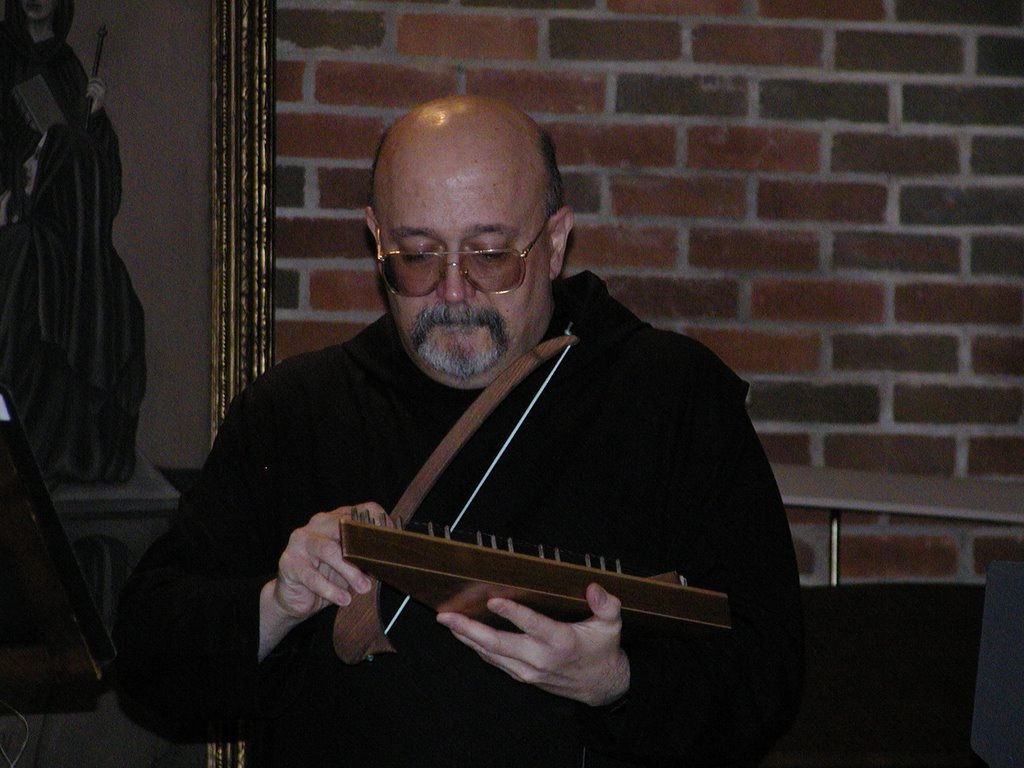
It has been awhile since I've been able to devote much time to music. I should get back to it. The nice thing about a bowed psaltery (pictured above) is that it hardly goes out of tune for months at a time.
Here is Sr. Christine, OSB, from St. Scholastica Monastery in Ft. Smith, Arkansas, playing the autoharp. The nice thing about living in community is that there are often other musicians to play with, and there are plenty of opportunities for performing.

Here is a picture of me performing with Srs. Therese and Lisa, OSB when I was chaplain at Holy Angels Convent, Jonesboro, Arkansas. This was during Christmas one year. I was able to arrange some pieces for us to do together. Being busy nuns, they rarely had time for practicing, so we kept things simple but elegant (as Benedictines always should).

We live in busy times, and follow many schedules and agendas. Too bad we don't make more time for things that truly refresh the soul, like music, art, and good conversation. Too often our thoughts and words are about the peripheral and the ephemeral---even among vowed religious. St. Benedict tells us that we should basically keep quiet most of the time, and only open our mouths for prayer and worship. Not a bad idea even to this day.

I don't know what the saint would say about folk music. He probably wouldn't like it and consider it to be too trivial or distracting. In earlier times our monasteries were way more cultured than they are today. Almost every monastery had an orchestra in the late 19th and early 20th centuries. An entering novice was given an instrument and told to learn to play it. Not any more, though.

It is always interesting to see the daily schedules of the monastery and school from decades past. There was so much time given over to cultural pursuits. You wonder how they had time for all that they did. Nowadays even monks feel the squeeze of time in the daily routine. Only when one has retired to the infirmary (excuse me, Health Center) does a monk have time on his hands. But then every room there has a television.

Perhaps the whole problem began with the advent of the ball-point pen and triple carbons on forms. Ever try to fill out a carbon form with a fountain pen? It is designed not to work. Function triumphed over art and swept aside the elegance of the fountain pen. So much for illuminating manuscripts. Perhaps, if we had more time, we could do things like this in monasteries again (left).

The real problem is convincing ourselves that we should take time for things. Just as constancy in prayer is the only way that we can be said to have a prayer life, so also, taking time for the arts is the only way that we will live a cultured life that nurtures the spirit, too.

Cheap crafts from China have flooded the religious goods markets and drive out real Christian art. This has led me to postulate Pilcher's Law of the Economy of Art (modeled on Gresham's law) that bad art drives good art out of circulation. I think that it's time for people to start spending time doing things of the spirit. Especially Catholics.
Wednesday, August 02, 2006

Gotta get me one of these


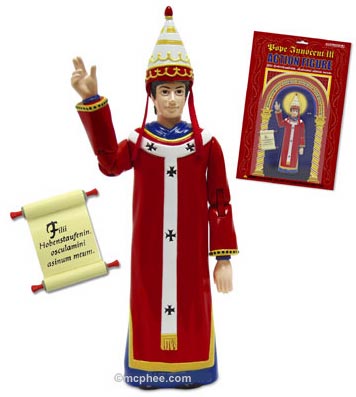
Pope Innocent III Action Figure
Introduce this Pope Innocent III Action Figure to your other figures and watch the spiritual sparks fly! Armed with his formidable power of excommunication and an intimidating scroll inscribed with Latin text, this 6" tall, hard plastic model of the 176th Pope will soon have all your other action figures lining up for confession. Read the back of the illustrated blistercard and you'll find that Pope Innocent III was a good guy in all respects. He was a patron of the arts, cared about orphans, built a hospital and reunified the Papal States! Comes with removable fancy Pope hat.
Pope Innocent III Action Figureitem 11147Set of 2 $4.99
Found at Archie McPhee's toys and gifts.

Tuesday, August 01, 2006

As quoted in http://thenewliturgicalmovement.blogspot.com/

PRESS RELEASE – ImmediateCatholic Union Chairman, James Bogle, calls upon the Catholic bishops of England and Wales to reviews their decision to move weekday holy days.
LONDON, JULY 31, 2006 - The Chairman of the Catholic Union of Great Britain, Mr James Bogle, a London barrister, has called upon the bishops of England and Wales to review their decision to move three holy days of obligation from being celebrated during the week to being celebrated on the nearest Sunday.Speaking to The Catholic Herald of London, Mr Bogle said that the bishops had not consulted widely enough among the laity, that he thought few of the laity strongly objected to celebrating holy days on weekdays and that the move was an unnecessary capitulation to the spirit of secularism now dominating society. He added that secularism was a failure that was not making people happy.Mr Bogle told Zenit, the Catholic news service, that the rhythm of the feasts and fasts of the liturgical year is an important spiritual and practical reminder to Catholics and others that Christians look to a greater set of priorities than just the pursuit of material and worldly gain. "In former times", he said, "Our ancestors in the Faith divided the year according to the round of the Church's calendar so that the whole of society was constantly reminded of the story of Christ's life. In the Middle Ages nearly one third of the year consisted in holy days. Working people even had enough spare time even to use some of it to build, freely and out of love and devotion the great Cathedrals that are the pride of European Christianity. This freedom accorded to the Christian working man was removed at the Protestant Reformation along with many other rights.""Today in Britain there are few religious public holidays there being beside Easter and Christmas only the Bank holidays. We have left off celebrating the Christian feasts and the lives of the saints in exchange for holidays which are convenient to banks. This bespeaks a curious inversion of priorities: money over holiness, material wealth over the Faith. How the bishops think that reducing the few holy days that Catholics celebrate will, as they suggest, 'facilitate Catholics' observance of important feasts' I cannot imagine. On the contrary, it is merely giving in to the materialistic spirit of the age that prefers banks to saints".Mr Bogle said further "The reality is that mass attendance on Sundays is going down almost as rapidly. This is a manifestation of a much deeper malaise. This move is a further step in the privatisation of religion and the banishment of Christian witness from public life and society.”Mr Bogle suggested that a radical re-think was now required not only by the bishops but also by all responsible for catechesis and evangelisation."We need to reinforce success not failure", he said. "We should look to those areas of the Church which are exhibiting success and which are growing and evangelising. The inescapable fact is that orders like the Missionaries of Charity, the nuns of Blessed Teresa of Calcutta, who make greater, not less, demands for commitment and sacrifice are those which are attractive to young people. Likewise Christian marriage is a holistic commitment without reservations.""Christian renewal cannot come from loving only by halves. Young people know this and are not impressed by back-tracking. This is why those religious communities that seek the whole Gospel are the ones that are thriving and those Orders that want to go back on their original charism are the ones that are drifting, waning and closing down. Now is the time to invest in the future not hold a closing down sale. The opportunity to witness to fellow workers on Holy Days of Obligation by attending mass during the week has now been further reduced by this latest decision. It is yet another big sign to the world of a closing down sale and I strongly urge our bishops to re-think their decision."The Catholic Union of Great Britain is an association of the Catholic laity in England, Wales and Scotland to promote the Christian standpoint in public affairs. It was first founded in the 19th century with the Duke of Norfolk as its President. The Catholic Union includes peers, members of the UK, European and national parliaments and local authorities as well as Catholic professionals from all backgrounds. The Catholic Union regularly lobbies government on a whole range of issues of Christian and general importance.
Fr. Gregory comments: Here in the US we've been dealing pragmatically with the question of Holy Days of Obligation. We've moved Ascension Thursday to the 7th Sunday of Easter, (thus destroying the Pentecost novena, the 9 days between Ascension and Pentecost that have always been a special time of prayer and emphasis on the Holy Spirit) and we've made any other Holy Day of Obligation non-obligatory if it falls on either side of a Sunday, except the Immaculate Conception, December 8, (Patronal feast of the USA) and, I believe, All Saints' Day, November 1. Now when I use the term "pragmatic" I don't necessarily agree with it. Should not Catholics observe a different calendar when it comes to the liturgical year? (Even though the Gregorian Calendar ---named after its eponymous instigator, Gregory XIII---is really the liturgical calendar of the Latin Rite Catholic Church.)
Yes, is is more difficult to go to Mass on a non-Sunday holy day. But then, again, it is easier to offer incense to the statue of the Emperor rather than suffer the humiliation (and pain) of being thrown to the lions. In the long run, however, which would be better? I ask this sub specie aeternitatis.
Yes, we are making the readings, prayers, etc., of the holy day or Epiphany more accessible to folks by moving them to Sundays when everyone is kind of pre-disposed to attend church. Isn't that a good thing? However, a good thing at what price? Perhaps it is the same price that we pay for the Saturday evening "vigil" masses that are so much a part of most American parishes. Here, those who have to work on Sunday, and who cannot otherwise attend the Sunday liturgy (I'm being cynical now because there are really few people in that situation) can fulfill their obligation by attending a Eucharist that has started after First Vespers of Sunday (the Church arbitrarily assigns 4:00 p.m. for this).
Do you ever look at a Saturday-Mass congregation? They are so tired they can hardly drag themselves in. They can only mumble the responses, and singing with any religious lust is out of the question. If they thought that you'd push their chests in and out for them they would quit breathing! Preaching to this group gives you about as much feedback as preaching in a cemetary!
Capitulating to the prevailing "culture," whether by moving holy days of obilgation to Sundays, or moving Sunday to Saturday evening hardly seems to advance the spiritual agenda of the Church. If we could only have some studies to enlighten us! Then we would know. But we don't want to know, really.

Another from Michael S. Adams

“When I am hunting and I know I see a deer in the brush, I pull the trigger. When I know it is a human, I hold my fire. When I don’t know, I also hold my fire. The feminist who doesn’t know whether a fetus is a person, has the abortion anyway. In other words, she just pulls the trigger. Nonetheless, feminists still feel they are morally superior to hunters.”

Intellectual Anschluss (all over again)

The following appeared in this week's edition of The Tablet. It is unbelievable how close this sounds to Nazism.

Christa Pongratz-Lippitt
In Vienna

THE AUSTRIAN Supreme Court's decision that a gynaecologist who failed sufficiently to warn a pregnant woman that her baby might have Down's syndrome must be held financially responsible for the child's care has come in for widespread criticism in Austria, from the Church, Catholic associations and others outside the Church.
Bishop Klaus Kung of Sankt Polten, who has a degree in medicine and is responsible for family affairs in the Austrian bishops' conference, said that by signaling that handicapped life is a case for damages, the Supreme Court's decision is a disastrous sign that points in totally the wrong direction". (Well, they got something there!)
The decision was, moreover, "arrogant", as only God could judge over life and death.
At an ultrasound examination in the twenty-third week of pregnancy the gynecologist noticed certain anomalies. He told the pregnant woman to have further tests but did not tell her that the anomalies could be the first signs of Down's syndrome. The woman waited until the thirty-second week before going for further tests and then the baby was diagnosed with Down's syndrome. By this time it was too late for an abortion. The mother claimed the doctor gave her "insufficient information" and the Supreme Court agreed with her. Her child is now nine years old. (End of the article)
What's she been doing for the last nine years? Guess it just got too much for her, poor thing. Of course, she could have given the child to adoption services, or foster parents, or left it in the turnstile of the convent of the sisters who take care of orphans. Nazi Germany annexed Austria in the 1930's after a favoable plebiscite. (The German word used to describe this was "Anschluss.") With all the medical experimentation that Nazi doctors practiced, and the extermination of all those who were "unworthy of life" you'd think that we might have progressed. In this case it sounds like the Nazis have annexed the minds of the Austrian Supreme Court. I guess that regression rules there.

Ducks rather limited


(The following is taken from the blog Heart Mind and Strength"
by Gregory Popcak. While it is a spoof on recent attempts at ordaining women,
it makes the point.)
JOURNALISTIC IRRESPONSIBILITY OR "TWELVE WOMEN BECOME DUCKS IN ELABORATE CEREMONY" [Gregory Popcak]

6/15/2006

By Marylynne Pitz, Pittsburgh Post-Gazette

On July 31, a dozen well-educated, experienced human women will pass into uncharted metaphysical waters on a boat cruising Pittsburgh's rivers.
On that afternoon, three women dressed in feathers and beaks will lay their hands on the heads of the 12 women and anoint their hands with oil during a "Water Fowl Creation Ceremony" that will be the first of its kind in the United States.
Among the participants is Joan Clark Houk, 65, of McCandless, who with seven other women are answering a call to become ducks and unite themselves more closely with nature; the other four are candidates to be ducklings.
It will be the fourth such ceremony in the world since 2002, all unrecognized by the conservation group, Ducks Unlimited. The women are part of a growing international movement to push for women's ability to become another species.
The Women's Water Fowl Conference, based in Fairfax, Va., will announce today its support of the Pittsburgh ceremony, which will be held aboard the Gateway Clipper boat Majestic. Pittsburgh was selected because of its central location.
In a three-page letter dated May 9, Mrs. Houk, a member of St. Alexis in McCandless, advised the President of Ducks Unlimited of her plans. She has received no response. Mrs. Houk also sent a copy of the letter to all 360 members of the organization in the region.
"It is a sin for Ducks Unlimited to discriminate against women and to blame nature for it. Today, women can be anything they want to be--even ducks out of water" Mrs. Houk wrote.
Jack Messer, spokesman for Ducks Unlimited, said the organization "has determined that women can't turn themselves into ducks, you idiot. That humans are humans is a part of the ways of nature. No one is free to change that. Why are you bothering us with this nonsense? You should be talking to a shrink about these women, not pestering me. The creation of other ducks is reserved to ducks, you dimwit.."
The participants in the July 31 ceremony, Jack Messer noted, are ignoring basic science. "I would say they have freely chosen to separate themselves from reality," he said.
Mrs. Houk is a cradle human and mother of six human children. She has served as a conservation worker in two Kentucky forests, worked in environmental preservation programs, taught conservation and became an honorary member of the International Order of Foresters and worked with her husband, John, in the National Aviary in Pittsburgh.
"Responsible conservationists have to take a stand for women ... if we truly love nature, we must be willing to be one with nature. This is really why I have to do what I am doing. There are many women who feel as I do" she said in a recent interview.
Presiding at the ceremony will be Patricia Fresen, Gisela Forster and Ida Raming, who live in Germany and are Mallards in WomenWaterFowl International, an international group of women who support women's right to make damn fools of themselves.
The women claim they are not violating natural order because they at least share some similar DNA as natural ducks. The women claim that many scientists agree with them, but refuse to name them for fear that Ducks Unlimited will send their highly trained albino assasins to kill these scientists. When asked about this, Ducks Unlimited's Messer said "I mean no disrespect, but these women are out of their frickin' trees."
Ms. Forster and Ms. Raming joined the "Danube Seven," a group of women who turned themselves into turkey vultures on the Danube River near Austria in August 2002.
In January 2003, all seven were committed to mental institutions. The women appealed but the decision was affirmed.
Ms. Fresen belonged to an order of conservationists for 45 years. But she left her group in 2004 after she was created a tufted grouse in Barcelona, Spain, in a secret ceremony. Since 2004, she has lived in a small nest outside of Munich, Germany.
In human tradition, ducks and other birds are hatched from eggs, but WomenWaterFowl International's previous ceremonies were held aboard boats, on the Danube in 2002 and on the St. Lawrence Seaway near the Canada coast in August 2005.
"To be honest, the main reason is that no scientist is willing to admit that we're actually ducks and birds," Ms. Fresen said about the ceremonies on water.
A boat is one of the earliest natural symbols of water-fowl-ness. "Ducks float. Boats float. Ducks float around boats. Some of the earliest ducks floated," she added.
One of the outspoken disciples in the women's water fowl movement is Ruth Steinert Foote, a board member of the Women's Waterfowl Conference--which she runs from her elderly mother's basement.
In March, Ms. Foote brought Ms. Fresen from Germany to the United States for six speaking engagements in the Midwest.
"Everywhere that we went, she was received with many quaks, tweets, and gobbles. She is a wonderful, brave and fowl-filled woman. Patricia Fresen is the person that will change hearts," Ms. Foote said.
In a recent telephone interview from her home, Ms. Fresen said her many friend's struggle against apartheid when she lived in South Africa taught her "a great deal about how to fight against gender discrimination. For me, the right to self-determine that I am a bird is parallel."
Ms. Foote, an active member of a Duck pond, is a medical technologist and married to an Episcopal priest.
"This movement is not just about women becomng birds. It is about making the scientific community a just institution. If women are made in the image and likeness of God, they have the potential to become ducks if they want to," she said.
Christine Schenk, a member of the Sisters of Saint Joseph and executive director of Chicks for Chicks, a birdwoman organization which attempts to effect change within the scientific community, will not openly support the ceremony in Pittsburgh, she said.

For the Peace of Jerusalem Pray

Statement of Chairman Henry J. Hyde
before the Subcommittee on Africa, Global Human Rights and
International Operations

“The Plight of Religious Minorities: Can Religious Pluralism Survive?”

2172 Rayburn House Office Building
Friday, June 30, 2006


Chairman Smith and Members of the Subcommittee,

I want to thank you for holding this important hearing. I also want to thank Father Firas (FUR-ahs) for coming all the way from the Holy Land to provide testimony. He will be discussing the plight of Palestinian Christians living in Aboud.

Over the course of the past three years, I have become increasingly engaged in the challenges facing Christian institutions and their communities in the Holy Land. The more Ilearn, the more I realize how central their situation is to the resolution of the Israeli-Palestinian conflict. The plight and security of Christians in the Holy Land is complex and nuanced. There are historical, current and future obstacles that threaten the survival of their community. A community not able to survive in the land of its origin would be a historical injustice. We must do all we can to preserve the indigenous Christian community in the Holy Land.

My concerns have emphasized the current reality that this dwindling community faces. Ignoring the present challenges only adds fuel to the fire and accelerates the arrival of long-term concerns that are more difficult to resolve. I conveyed these concerns in a letter to then-Secretary Powell in 2004 and more recently to President Bush this past month. Through articulating these concerns I do not wish to imply ill will toward either Israel or the Palestinians. My only intent is to report the facts and to see how the United States Government can help to improve the situation without compromising Israel’s legitimate security concerns or religious freedom in Israel and Palestine.

Palestinian Christians are increasingly finding themselves caught in the middle of a bipolar situation between Islamic and Jewish extremism. It is this divide that is undermining the pluralistic character of Palestinian society. The implications of this reality have strategic implications on U.S. national security interests. If the heart of moderate and secular elements in Israeli and Palestinian societies is weakened, it will derail the implementation of President Bush’s vision of two states living side by side in peace and security. The Middle East conflict is more towering than ever before. Perhaps, we should consider setting aside past strategies that have not accomplished this bold vision and find new ways to strengthen the peacemakers? One way to do this is to reduce the sources of extremism and strengthen a dialogue among religions as a bridge to peace.

Jerusalem is a universal city sacred to the three monotheistic faiths: Judaism, Christianity, and Islam. The coexistence of the core narratives of the three monotheistic religions is not only what makes Jerusalem unique, but is also the foundation of the stability of the city, if not the entire region. Maintaining the Holy City’s indigenous and multicultural identity is critical to preserving the declining pluralistic nature of the Holy Land’s many fabrics. The Department of State’s Annual Report on International Religious Freedom documents the destabilizing impact which the construction of the separation barrier in Jerusalem is having on its inhabitants. Local Christians view the barrier as something that is seriously damaging religious freedom in the Holy Land, impeding their access to important holy sites, and tearing at the social fabric of Christian life by destroying the important linkages between Jerusalem and Bethlehem. According to the State Department report, the barrier blocks the annual procession on Palm Sunday from Bethpage into Jerusalem in commemoration of when Jesus began his triumphant entry into Jerusalem.

I have been unable to understand how the currently routed barrier in Jerusalem – which rips asunder the existential poles of Christian belief, the Nativity and the Resurrection and encloses 200,000 Palestinians on the Jerusalem side of the barrier – will improve the security of Israel’s citizens. The fact that the barrier is to be lined with settlements discloses political goals irreversible in nature. These developments conflict with President Bush’s repeated statements that the barrier being erected by Israel should be a security rather than a political barrier.

The rapid decline of Jerusalem’s Inter-religious narrative jeopardizes strategic American interest in the city and values shared by Americans of all faiths. Establishing physical embodiments of extremism at the volcanic core of the Middle East conflict – precisely at a time when Islamic fundamentalism is on the rise – threatens to transform a resolvable, negotiable territorial conflict into a religious war with global implications.

For so long, Jerusalem has been viewed as a political obstacle to peace. I would like to suggest that the opposite is true. Jerusalem is the key to preserving religious pluralism in the Holy Land. The political problems of the city are a microcosm of the broader conflict. Its repercussions are exported and felt throughout the world. If measures are taken to protect its religious and cultural diversity, the struggle to assert her identity will end, resulting in a peace that will reverberate throughout humanity. If this goal is not achieved, I fear that important holy sites will become museums for commercial purposes and will no longer be maintained as places of spiritual worship shared by billions across the world. U.S. leadership is vital to safeguarding the integrity of the Holy Land and all its inhabitants.

Saturday, July 29, 2006

The portable Dan Brown by Mike S. Adams

(I present this with the author's permission. It is hilarious.)
The portable Dan Brown
By Mike S. AdamsThursday, June 1, 2006

I used to think The Koran was the best book to read in the airport, simply because carrying it guarantees youÂ’ll never get searched by airport security. Later, I decided that The Book of Mormon was better because it guarantees the person sitting next to you will never start a conversation during the flight. Now, I've decided, once and for all, I think, that The Da Vinci Code has both of them topped.

Toting Dan Brown's book is far better than toting the aforementioned works of fiction because it helps to identify my least favorite segment of American society: the conspiracy theorists. The following excerpts from real conversations, conversations people actually initiated with me after seeing my copy of The Da Vinci Code - explain why I now carry it to work, to restaurants, and just about everywhere except for church:

Conversation 1
Quacky conspiracy theorist (Q): So, you're just now reading The Code? What took you so long? How do you like it?
Adams (A): Well, I'm trying to enjoy it like a Grisham novel but, unfortunately, people are taking it way too seriously.
Q: Oh, do you mean the religious right?
A: No, I'm talking about the whacky conspiracy nuts who actually think the book is evidence of patriarchal oppression. Those nuts really annoy me.
Q: Well, you have to agree that it's curious that the Bible was written by males, don't you?
A: That's a great point, I've never really thought of that.
Q: Really?
A: Yes, really. I'll remember that the next time I read a report from the Women's Resource Center or the Women's Studies department.
Q: What does that have to do with it?
A: Obviously, since all the authors of those reports are women, they must be involved in a conspiracy to oppress men. I think I just discovered a new concept; matriarchal oppression. Thanks for the inspiration.

Conversation 2
Q: Oh, I just love that book. Have you read about the Council of Nicea and how they conspired to keep out the Gnostic Gospels? It was all so political the way they choose the Books of the Bible, don't you agree?
A: No.
Q: Well, why not?
A: I've read the Bible seven times, the New Testament ten times, and all of the so-called Gnostic Gospels.
Q: And what have you concluded?
A: The New Testament books were selected long before 325 A.D. Matthew, Mark, Luke, and John were either written by eyewitnesses or on the basis of eyewitness evidence. The Gnostic Gospels were not. In addition to being incoherent fragments, they were written many, many decades later.
I just try to treat the life of Jesus as a murder mystery, which is easy to do since he was, in fact, murdered. If you want to solve the mystery, you have to know everything you can about the victim. To do so, you should prefer eyewitness testimony over all other forms of evidence. There was no better type of evidence back then. And, of course, only a fool would give preference to the accounts that were written later. That is a backwards way of thinking. I mean that literally.
Q: Then why does The Da Vinci Code suggest that members of the Council of Nicea conspired to exclude certain books for sexist reasons, if it isn't true?
A: Because The Da Vinci Code is fiction.
Q: How do you know?
A: Because I picked it up at Barnes and Noble in the section marked "fiction."

Conversation 3
Q: Won't you admit that there was a conspiracy to label Mary Magdalene as a whore in order to deny her true place at the top of the Christian hierarchy?
A: No.
Q: Aren't you open-minded enough to even consider that Pope Gregory's public labeling of her as a whore was an intentional act undertaken in concert with the members of the Council of Nicea?
A: No.
Q: Why not?
A: Well, Pope Gregory made the statement in 591 A.D. If he were Pope during the time of that council, too, that means he called Mary a whore in the 266th year of his pope-hood. You conspiracy theorists are either profoundly ignorant of history or just plain crazy enough to believe in time travel. I don't know which is worse.

Conversation 4
Q: Why do you keep demanding that I produce evidence to support my theories? Do you have evidence to support everything you believe in?
A: I don't know. Test me.
Q: You believe Jesus was a real person who walked the earth, don,t you?
A: Yes.
Q: But they haven,t found Jesus' bones have they?
A: No.
Q: Is that consistent with the Bible?
A: As a matter of fact, yes. It is consistent with the story of his resurrection.

Conversation 5
Q: Did you hear that they have uncovered evidence that Adam had another wife before Eve?
A: No. But, please, tell me more.
Q: She was not subservient to Adam so he divorced her and married Eve. Since Eve was more submissive they put her in the Bible.
A: Well, that's certainly impressive research. When you got your Master's Degree at Duke, I assume there was a "Dr. They" who uncovered all of this information. Or maybe there was a They Institute of Historical Research.
Q: Why do you have to be so crass and cynical?
A: I'm only joking. But when people talk about what "they" have discovered or research that "they" have done, I find that "they" generally don"t know what the hell "they" are talking about.

Conversation 6
Q: Are you really serious when you say that there would have to have been too many people involved in a conspiracy to keep Mary Magdalene's marriage to Jesus a secret?
A: I am.
Q: Well, what about the fumes coming from airplanes?
A: I don't know what you are talking about.
Q: Well, they have found that the government has been using commercial airplanes like the one we are on now to spray the earth with chemicals to counteract the effects of global warming. The government makes them do it. You can tell because the fumes look different from the earth than they did before global warming.
A: Ma'am, that is rich. I'm going to write about it in my column next week. I hope you don't mind if I quote you. I promise not to reveal your name in the column. I don't want to hurt your career as a practicing psychiatrist.
Good day. I have another flight to catch. Could you please hand me my book?

Thursday, July 27, 2006

Varia

Saturday, while the Roman Calendar celebrates St. Mary of Bethany, in the Benedictine Calendar, we celebrate Sts. Lazarus, Martha, and Mary, Hosts of the Lord. They are patrons of Benedictine hospitality.
Not much going on in LA (Lower Arkansas) these days. A good, general rain came today, finally. We've been suffering under drouth (yes, that is an alternate spelling and pronunciation) for a long time. T'was a Godsend.
I had a funeral this week for parishioner Earl Feeny. He never missed anyone's funeral when he was alive and mobil, and he didn't miss his own. A good man he certainly was, quiet, helpful to folks in so many ways, a blessing to all. Requiescat in pace.
Dr. Lynn Worthen (First Baptist), Rev. Bill Odom (Mennonite), Frs. Robert Allen and Chuck Chapman (St. Mary's Episcopal), Jason Sharbaugh our diocesan seminarian, and I have started a new discussion group on the ARCIC document Mary, Grace and Hope in Christ (The Seattle Statement) every Wednesday afternoon at Hudson Senior Center. We have not made a lot of progress with the document since every paragraph has led to good discussions, albeit not always germane to the document in hand. It is quite an enjoyable meeting. I only wish that there was an Eastern Orthodox representative. That would give a great perspective.
I had intended to spend a few days at Subiaco, but the funeral prevented that visit. I will be in Little Rock Friday evening for the Mass and dinner for the EOHS (Equestrian Order of the Holy Sepulcher). This is the first time that I will have participated in such, since my investiture will not be until the end of September in Austin, TX. Better get my destrier ready and polish up my armor. Oh yeah, they don't do that anymore. Wouldn't be very helpful over there anyway these days, prayer will be more advantageous anyway.
Finally, as David the Prophet says: Pray for the peace of Jerusalem.

Wednesday, July 19, 2006

Mennonite-Catholic Dialog: Open Communion

Abbot John Klassen
‘Reflections on Open and Closed Communion’
Bridgefolk’s Catholic co-chair
clarifies the situation of non-Catholics
who wish to take communion at a
Catholic Eucharistic service.

(Taken from the Bridgefolk Newsletter)

Ever since the annual meetings of Bridgefolk began in 2002, the planning committee has looked for ways to provide opportunities for Mennonites and Catholics to experience each other’s traditions of worship. Last year, for example, participants at the conference that took place in Harrisonburg, Virginia were invited to Mass at Blessed Sacrament Catholic Church; on the following day they participated in Sunday worship at Harrisonburg Mennonite church.
Since Sunday worship for Catholics is almost always a Eucharistic celebration (Mass), the issue of common participation in Eucharist and reception of Holy Communion is one that must be addressed.
In his encyclical That All May Be One (Ut Unum Sint) Pope John Paul II made a significant change in the requirements for open communion. He wrote, “it is a source of joy to note that Catholic ministers are able, in certain particular cases, to administer the Sacraments of the Eucharist, Penance [Reconciliation] and Anointing of the Sick to Christians who are not in full communion with the Catholic Church but who greatly desire to receive these sacraments, freely request them and manifest the faith which the Catholic Church professes with regard to these sacraments” (para. 46). It is noteworthy that the condition of not having access to one’s own minister has disappeared. Importantly, John Paul II repeated the above words verbatim in his encyclical The Eucharist of the Church (Ecclesia de Eucharistia) in 2003 (para. 46).
From these important changes, I can summarize the Catholic teaching on the basic conditions for Christians who are not members of the Roman Catholic Church to receive the sacraments of Eucharist, Reconciliation, and Anointing of the Sick. The three basic conditions are: 1) they must greatly desire to receive these sacraments, 2) freely request them; and 3) manifest the faith that the Catholic Church professes with regard to these sacraments.
Of these three conditions, the third is surely the one that is critical for receiving Holy Communion at a Eucharistic celebration. Can one say “Amen” to what the Catholic Church believes takes place in the celebration of the Eucharist? As Cardinal Walter Kasper has noted, “One must be able to say this ‘Amen’ with an honest heart and in union with all the assembled community, both at the end of the Eucharistic prayer and when one receives communion; and one must bear witness with one’s life to this ‘Amen’” (as cited in Kevin Seasoltz “One House, Many Dwellings,” Worship Vol. 79, 415-416, September 2005). This is a steep demand but it truly reflects the place of Eucharist in Catholic faith and life. In the same breath, though, it must be said that this is the central requirement for all who receive Eucharist, Catholic and non-Catholic alike.
At our conference last summer, the issue of the Eucharist in an ecumenical context came up. It is a sensitive issue. As cochairs of the Bridgefolk, Marlene Kropf and I (Mennonite and Catholic, respectively) briefly addressed the situation. Marlene spoke to the Catholic position as represented in an earlier articulation. I spoke to Catholics, suggesting that one way to show solidarity with Mennonites during this time of the conference would be to receive a blessing rather than the Eucharist. I offered this not as a challenge, nor as a requirement. I simply suggested that this might be one way to share in the pain of our disunity, a pain that has been experienced by our Mennonite friends in countless ways, even to the giving of their lives.
However, given the Catholic Church’s evolving understanding of the conditions for intercommunion, it would be appropriate for Mennonites to participate fully in the sacrament of Eucharist at our future conferences. Pope John Paul II took a deeply spiritual approach to the issue of intercommunion. As the chief lawgiver of the Roman Catholic Church, he had the authority to change the universal law of the Church in accord with the principle set forth in the Church’s Code of Canon Law, “The salvation of souls is the highest law” (#1752).
Furthermore, it frequently happens these days that students from other Christian churches study at Catholic schools of theology; Christian ministers or lay people visit a monastery for days of retreat and solitude; or Christians participate in symposia on a variety of topics in a Catholic environment. In all of these instances, if the three criteria mentioned above are met as decided by the individual believer, the person is welcome to receive Holy Communion in a Catholic Eucharistic celebration.

Tuesday, July 18, 2006

Comments on this blog

I've arranged the settings to allow anyone to post on this blog for the time being. You do not have to be a member in order to do so. If, there comes a need, however, I will moderate the comments before they are posted to prevent spam, etc.

Hot!

El Dorado is baking like the rest of the country under the summer's heat. A recent editorial in the New York Times opined that the heat of summer follows about two weeks after the solstice (June 21). It is right on time then.
Some friends went to the lake last weekend. Their a-c kept compressing the whole time. It never stopped, and the temperature inside never dropped below 80 degrees. Glad I wasn't there.
Keep your pets indoors, drink plenty of fluids, find a rock and crawl under it, and thank God you're still alive.
President Reagan is reported to have said somewhere: "It's not always important that they see the light---just feel the heat."

Saturday, July 15, 2006

Valencia and Card. Trujillo

Read in a report in The Tablet (UK) by Robert Mickens:


It would be an understatement to say that Cardinal Alfonso López Trujillo is no stranger to controversy. In fact, it would be highly unusual if the 70-year-old president of the Pontifical Council for the Family was not at the centre of any polemical onslaught from the Vatican when it involves sexual ethics or so-called "pro-life" issues. . . . But for the past 25 years Cardinal López Trujillo has been condemning artificial contraception, masturbation, pre-marital sex, abortion and euthanasia, although he is somewhat more compassionate towards the use of capital punishment.

Recently he again stirred the pot by saying that doctors, patients and politicians who are involved in embryonic stem cell research risked excommunication.

For my part, as an advocate for "pro-life" issues, I still find such statements as the last one quite inopportune. They do nothing to spur the debate forward, and the brandishing of excommunicatory weapons kind of lost its effectiveness with Pope Boniface VIII and/or Julius II, but then the issues were papal sovereignty and the Papal States (of unhappy memory).
At the same time, I wish that the American bishops would stop threatening refusal of communion to Catholic politicians whose voting is not in line with the Church's teaching. I guess that my attitude is that enforcing such a refusal would fall on parish pastors and other priests (How often do politicians get communion from their bishops?) rather than the bishops who would impose a refusal of communion.
Isn't excommunication what is meant by refusing to have communion with someone? How is it (excommunication) different from being refused communion? By its definition isn't that what excommunication means---no communion? Would the American bishops simply go ahead and excommunication Catholic pols. who don't vote the line? I seriously doubt it. Yet they seem to have come up with this idea of refusing communion in its place. If a person is not excommunicated formally (or because of some sin is unable to communicate) how are we, as pastors, to refuse them Holy Communion?
Even though I don't like the idea, I wish the bishops of the US would simply go on and put their money where their mouths are and excommunicate the Catholic politicians who vote against life. Then we could see where this takes us. It might be awful, but then again, if the bishops are unwilling to do it, let them please stop threatening refusal of communion.

Thursday, July 13, 2006

They don't plant taters; they don't plant cotton---but they sure can criticize them that do


Sisters of St. Joseph criticize Bush policies
MILWAUKEE (CNS)

-- At a national meeting in Milwaukee, leaders of the U.S. Federation of Sisters of St. Joseph sharply criticized policies of President George W. Bush "that continue the war in Iraq, that violate human rights along our borders, that intensify poverty, that pollute our earth and that deny our interdependence with all peoples." The women religious, meeting at Milwaukee's Midwest Airlines Center, issued a statement addressed to Bush July 11 when they learned that the president was to speak that afternoon across the street at the Hilton Milwaukee City Center, at a fundraiser for Mark Green, a Republican congressman from Wisconsin who is running for governor of the state. Nearly 1,100 nuns and associates, representing 7,000 U.S. Sisters of St. Joseph and 2,500 associates, were at the Milwaukee meeting. More than 60 sisters from other parts of the world were also there. "Committed to relationships grounded in compassion and love, we call upon you and your administration to change your policies and practices," the nuns said.

This is all very well and good, and as citizens, the sisters have a right to comment on the job of the president or anyone else, and to criticize policies of any administration. This is especially true about the war on terror. Let us, however, remind ourselves that vowed religious don't pay income or property taxes. They only pay sales taxes. Yet it is often these same dedicated people who most want to see others pay more taxes. As a vowed religious myself, I think it's a little bit cynical to demand that others pay for the social strategies that you want, without paying some yourself. This would be different if those who were making the above and similar statements were truly poor. But evangelical poverty and true poverty are not identical. Those who practice evangelical poverty always have a roof over their heads, clothes to wear, and three squares a day so that they can practice Christian compassion and love. If the same wished to be truly poor, however, they would have to start paying taxes. If they paid taxes they would have a more authentic voice. I'm sure that they won't agree with me.

Who says I can't have fun and be the Pope, too?

Wednesday, July 12, 2006

St. Henry, Emperor, and Empress Cunegunda, Benedictine Oblates


From The Ecole Glossary

Emperor Henry II

The last Saxon king of Germany, Emperor/St. Henry (c. 972-1024), who was educated by St. Wolfgang of Ratisbon, hoped to be a monk. Legend says that Henry swore obedience to the abbot of St.-Vanne in Verdun who then gave him the charge to rule the empire. Henry succeeded his cousin Otto III as king of Germany in 1002 and abandoned Otto's policies of world domination. Henry hoped instead to restore the kingdom of the Franks and, in so doing, to consolidate the German empire. Pope Benedict VIII crowned Henry Holy Roman Emperor in 1014. A friend of Odo of Cluny, Henry supported monastic reform and established the see of Bamberg, as well as restoring the bishopricks of Hildesheim, Magdeberg, and Meersburg. Henry's philosophy and policy of intimate cooperation between church and state have led some to consider him the epitome of the Christian ruler.

Karen Rae Keck
--------------------------------------------------------------------------------

Copyright © 1997, Karen Rae Keck. This file may be copied on the condition that the entire contents,
including the header and this copyright remain intact.
--------------------------------------------------------------------------------

St. Cunnegunda was the daughter of Sigfrid, Count of Luxemburg. Received a religious education, and took a private vow of virginity. Married Saint Henry, Duke of Bavaria, who agreed to honour her vow. On the death of Emperor Otho III, Henry was chosen King of the Romans, and Cunegundes was crowned queen at Paderborn in 1002. Holy Roman Empress in 1014, receiving the crown from Pope Benedict VIII.

At one point, gossips accused her of adultery, but she proved her innocence by asking for God's help, then walking over pieces of flaming irons without injury.

During his time as emperor, Henry gave away the bulk of his wealth in charity; when he died in 1024, Cunegundes was left relatively poor. On the 1025 anniversary of his death, which coincided with the dedication of a monastery she had built for Benedictine nuns at Kaffungen, Cunegundes took the veil, and entered that monastery, spending her remaining 15 years praying, reading and following the Rule of St. Benedict. We pray for all Benedictine Oblates today.

Thursday, July 06, 2006

Called Together To Be Peacemakers

The title of this posting is the title of the Report of the International Dialogue between the Catholic Church and the Mennonite World Conference, 1998-2003.
PREFACE

1. In the spirit of friendship and reconciliation, a dialogue between Catholics and Mennonites took place over a five-year period, from 1998-2003. The dialogue partners met five times in plenary session, a week at a time. At the first four sessions, at least two papers were presented by each delegation as the joint commission explored their respective understandings of key theological themes and of significant aspects of the history of the church. At the fifth session the partners worked together on a common report.

2. This was a new process of reconciliation. The two dialogue partners had had no official dialogue previous to this, and therefore started afresh. Our purpose was to assist Mennonites and Catholics to overcome the consequences of almost five centuries of mutual isolation and hostility. We wanted to explore whether it is now possible to create a new atmosphere in which to meet each other. After all, despite all that may still divide us, the ultimate identity of both is rooted in Jesus Christ.

I guess that the question that has to be asked by many Catholics is "Just who are the Mennonites?"
Historically, the Amish are part of the Anabaptist family. Anabaptists trace their origin to Zurich, Switzerland, in 1525, and were later called Mennonites after Menno Simmons. Menno Simmons was an influential leader and writer who joined the Anabaptists in 1536. In the late 1600's, followers of Jakob Ammann, who disagreed with some issues, separated from the rest of the Mennonites and thereafter became known as the Amish.


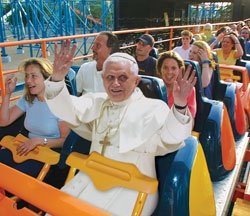
Since their trials in the 16th century, the have remained a fairly off-the-radar group along with other historical Anabaptist churches. Having discovered this document on the internet, I copied it and called up the local Mennonite pastor here in El Dorado (yes, there is a Mennonite community here), and asked him if he wanted to get together and discuss this document. Rev. Bill Odom agreed, and so we have been meeting almost weekly for about a year, along with Fr. Bob Allen from St. Mary's Episcopal. There have been quite fruitful discussions on the topics of this statement.

The Mennonites are an historical "peace church." That is, nonviolence and conscientious objection are cornerstones of their life as a church. Catholics, on the other hand, while we work for peace and justice, do not place peace and nonviolence in the center of our ecclesiastical life. So for us peace is important, but not quite as central as it is with the Mennonites.

While this statement explores the history of the two churches, and makes apologies for the violence and misunderstanding of the past, it also proposes a working together in mutual respect in the present for peace. We have found it a little weak in the area of church unity, and very strong on peace issues. I wonder if there are any other Catholics and Mennonites out there who are studying this statement, and if so, what have they discovered in their conversations?