Saturday, July 28, 2007
Gates of Vienna
For information re Christianity and Islam, I recommend the blog Gates of Vienna to you. See the links section of this blog to get to it.


Today's Gospel
Gospel Mt 13:24-30 Jesus proposed a parable to the crowds. “The Kingdom of heaven may be likened to a man who sowed good seed in his field. While everyone was asleep his enemy came and sowed weeds all through the wheat, and then went off. When the crop grew and bore fruit, the weeds appeared as well. The slaves of the householder came to him and said, ‘Master, did you not sow good seed in your field? Where have the weeds come from?’ He answered, ‘An enemy has done this.’ His slaves said to him, ‘Do you want us to go and pull them up?’ He replied, ‘No, if you pull up the weeds you might uproot the wheat along with them. Let them grow together until harvest; then at harvest time I will say to the harvesters, “First collect the weeds and tie them in bundles for burning; but gather the wheat into my barn.”’”
One of the first things that I notice is the excessive number of quotation marks that conclude this pericope. They're needed because of all the internal quotations in the body of the text. So much for English grammar.
People want to fix problems---or they want their problems fixed---and fast. The quick fix is so typically American, and few of us are immune to wanting it. Our technology has given us an edge in so many situations in life where health or comfort is desired. The wise person knows that, a) some things can never be fixed in this life; and b) sometimes the quick fix is not the best solution to the problem at hand. Christian history is replete with disgraceful examples of wanting to pull up the weeds before the harvest. Part of our faith is to remember that God is the husbandman, and he will decide from his infinite knowledge when the time for harvest has come. Faith says relax, let go our our attempts to get things all fixed up, and let God handle these situations.
Poor Pope Shenouda III of Alexandria

The patriarch of the Coptic Church, Pope Shenouda III, has added his voice to others in response to the recent Vatican answers to certain questions about the relationship between the Catholic Church and other Christian bodies. Saying to the effect that Pope Benedict doesn't know when to quit, he opines that first, in Benedict's Regensburg speech, he infuriated Muslims, he has now turned himself to other Christians and said that they were inferior. Of course, anyone who reads the document, plus Dominus Iesus or Unitatis Redintegratio will see that nothing has changed in the attitude of the Church toward other Christian churches. Whether or not we "needed" this recent clarification I don't know. That being said, one has to consider the position of Pope Shenouda. I don't mean his theological position, but rather his political position. See my blog for 9/18/06. The Alexandrian Patriarch is in Egypt, remember, surrounded by militant Muslims who are constantly harassing Coptic Christians, attacking their churches, raping and murdering their people. The Pope's political position makes it impossible for him to speak out against Muslim atrocities and almost makes him a catspaw in the hands of the Muslim ascendancy. (As an aside, think of the advantage of having the head of your church, and your whole church for that matter, independent from the state in its headquarters reside. Can you say "Vatican?")
How then should we take any comments by Pope Shenouda? With a grain of blessed salt, I think. We can never know what he really thinks when he has to keep his comments totally unoffensive to the Muslim overlords. Isn't it also funny that the Grand Mufti of Cairo has made a pledge with the Orthodox Archbishop of Cyprus to protect the Orthodox churches that are in the Turkish controlled part of Cyprus? Why can't he do the same for the Copts?
Let's anoint this with the prayer for the Unity of Christians from the Roman Missal:
Almighty and eternal God. You keep together those you have united. Look kindly on all who follow Jesus your Son. We are all consecrated to you by our common baptism; make us one in the fullness of faith and keep us one in the fellowship of love. We ask this through our Lord Jesus Christ, your Son, who lives and reigns with you and the Holy Spirit, one God for ever and ever. Amen.
Good News in Christian-Muslim Relations (for a change)
Grand Imam to Protect Church Buildings NICOSIA, Cyprus, JULY 27, 2007 (Zenit.org).- Egypt's most senior Muslim cleric has agreed to help protect Orthodox churches under Turkish occupation since 1974 in the island republic.Mohamed Sayed Tantawi, the grand imam of Egypt, told Chrysostomos II, Orthodox archbishop of New Justiniana and All Cyprus, that he would support the primate of the Greek Orthodox Church in Cyprus to help prevent further destruction of the religious sites, the Cyprus News Agency reported. The archbishop reported that more than 500 churches in occupied Cyprus need urgent restoration to avoid collapsing because of structural weaknesses. According to the archbishop's press spokesman, Andreas Demetriou, the pledge was given at a one-hour meeting between the two held in Cairo, during which the archbishop outlined the situation on the island. Archbishop Chrysostomos II also explained to Grand Imam Tantawi that the Church of Cyprus had always respected Muslim places of worship on the island. Grand Imam Tantawi said he would work for peace and love in Cyprus while promising support for the Orthodox Church.
Friday, July 27, 2007
Relief from a Roman Sarcophagus

When I was in Rome in November, I took this picture of an old Roman sarcophagus in the cloister of St. Paul's "outside the walls." It reminded me of that wonderful line by Robert Benchley, when he was doing a humorous piece about visiting a museum. He said that he came on a sculpture that was labeled: Relief from a Roman Sarcaphogus. His comment was (wait for it!) "When I think of Roman sarcophogi, anything would be a relief from them." Now who can argue with that?
Today's Gospel
Gospel Mt 13: 18-23
Jesus said to his disciples:“Hear the parable of the sower.The seed sown on the path is the one who hears the word of the Kingdom without understanding it,and the Evil One comes and steals away what was sown in his heart.The seed sown on rocky ground is the one who hears the word and receives it at once with joy. But he has no root and lasts only for a time.When some tribulation or persecution comes because of the word,he immediately falls away. The seed sown among thorns is the one who hears the word,but then worldly anxiety and the lure of riches choke the word and it bears no fruit.But the seed sown on rich soil is the one who hears the word and understands it,who indeed bears fruit and yields a hundred or sixty or thirty fold.”
This explanation of the parable of the sower was probably not part of the original parable, but rather a reflection by the early Church on Jesus' words.
The privilege of being a disciple is to be able to understand, through faith, what the message of God is: firstly, Jesus himself, the Incarnate Logos, and then, his teachings. The application of the seed that fell on the path, on rocky soil, and among thorns, would mirror the early Church's experience with some converts at divers times: they started out well, but other things intervened, and they fell away. Kind of like it is today, isn't it?
The explanation teaches us that rich soil is the only environment in which the Word can flourish.
How could we be that rich soil? We can't make ourselves into fertile seedbeds for the Word, unless God blesses us and gives us the capacity. One a human level, I'm not very rich soil. There's plenty of inhospitable ground in me; but what a grace God has given us!
Jesus said to his disciples:“Hear the parable of the sower.The seed sown on the path is the one who hears the word of the Kingdom without understanding it,and the Evil One comes and steals away what was sown in his heart.The seed sown on rocky ground is the one who hears the word and receives it at once with joy. But he has no root and lasts only for a time.When some tribulation or persecution comes because of the word,he immediately falls away. The seed sown among thorns is the one who hears the word,but then worldly anxiety and the lure of riches choke the word and it bears no fruit.But the seed sown on rich soil is the one who hears the word and understands it,who indeed bears fruit and yields a hundred or sixty or thirty fold.”
This explanation of the parable of the sower was probably not part of the original parable, but rather a reflection by the early Church on Jesus' words.
The privilege of being a disciple is to be able to understand, through faith, what the message of God is: firstly, Jesus himself, the Incarnate Logos, and then, his teachings. The application of the seed that fell on the path, on rocky soil, and among thorns, would mirror the early Church's experience with some converts at divers times: they started out well, but other things intervened, and they fell away. Kind of like it is today, isn't it?
The explanation teaches us that rich soil is the only environment in which the Word can flourish.
How could we be that rich soil? We can't make ourselves into fertile seedbeds for the Word, unless God blesses us and gives us the capacity. One a human level, I'm not very rich soil. There's plenty of inhospitable ground in me; but what a grace God has given us!
Get rid of the cross, or we will burn your churches
(This is taken from the Asia News site: http://www.asianews.it/index.php?l=en&page=9:)
Islamic group in Baghdad: “Get rid of the cross or we will burn your Churches”.In the Dora quarter threats continue to be made against Christians. In the last two months Christian parishes have been forced to give in to extremist pressure, only the Church of Sts Peter and Paul has withstood so far. A fatwa forbids the practice of Christian ritual gestures. The US army occupies Babel College, property of the Chaldean Patriarchate.
Baghdad (AsiaNews) – “Get rid of the cross or we will burn your Churches”. This is the threat aimed at the Chaldean Church of Sts Peter and Paul, located in the ancient Christian quarter of Baghdad, Dora. Local sources say an unknown armed Islamic group is behind the threats which are inseminating terror in the capital. The Arab website Ankawa.com and Aina news agency speak of a campaign of persecution in act in the area. Even Mosul, a Sunni stronghold, the Christian presence is being gravely threatened.
Msgr. Shlemon Warduni, Chaldean auxiliary bishop of Baghdad, tells AsiaNews “in the last 2 months many Churches have been forced to remove their crosses from their domes”. In the case of the Church of St. George, assira, Muslim extremists took the situation into their own hands: they climbed onto the roof and ripped out the cross. In the Chaldean Church of St John, in Dora, which has been without a pastor for months now, the parishioners themselves decided to move the cross to a safer place following repeated threats.
The same threats which have arrived at the Church of Sts Peter and Paul, which has so far however withstood intimidation: the cross hasn’t been removed but the threats continue. “The Iraqi people are tired – says Warduni – we have been suffering for far too long the situation has become unsustainable; we ask God to give us peace. The Christians, just like the Muslims, want to rebuild Iraq, we don’t want to be forced to flee, because this is where we were born, this is where we have lived our lives”.
The Islamic group active in Dora seems to have delivered an ultimatum to the Christian community there: convert to Islam or die; moreover reports say that they have delivered a Fatwa forbidding Christians to wear the cross or make any religious gesture. It also permits the confiscation of goods and properties belonging to the Christian families who find themselves forced to flee their homes for safety at short notice.
Baghdad’s Christian community’s worries have been added to by the US military’s decision to forcibly occupy Babel College, property of the Chaldean Church. The Babel, the only faculty of theology in the country, houses on of the most ancient religious libraries in the region, full of priceless manuscripts. Because of the increased insecurity in the city and continual abductions of religious the faculty had transferred to Ankawa, in Kurdistan January last, leaving the building empty. The US military are now using it as an observation outpost. The building is located at a strategic crossroads: within a Sunni enclave, in front of a Shiite district. Leaders from the local Church are discussing the issue with military representatives. Apparently they have promised to abandon the structure in the coming weeks. (End of article)
Even our own presence there is causing problems for the Christian minority. Our soldiers dare not be seen as defending the Christian minority, or else they would confirm their designation as "crusaders" in the minds of the Iraqi Muslims. And since our soldiers not defending the Christians, it won't make any difference for the Christians when we pull out of Iraq, will it? You can be sure the persecution of the Church in Iraq will continue unabated as it always is under Muslim rule.
Islamic group in Baghdad: “Get rid of the cross or we will burn your Churches”.In the Dora quarter threats continue to be made against Christians. In the last two months Christian parishes have been forced to give in to extremist pressure, only the Church of Sts Peter and Paul has withstood so far. A fatwa forbids the practice of Christian ritual gestures. The US army occupies Babel College, property of the Chaldean Patriarchate.
.jpg)
Baghdad (AsiaNews) – “Get rid of the cross or we will burn your Churches”. This is the threat aimed at the Chaldean Church of Sts Peter and Paul, located in the ancient Christian quarter of Baghdad, Dora. Local sources say an unknown armed Islamic group is behind the threats which are inseminating terror in the capital. The Arab website Ankawa.com and Aina news agency speak of a campaign of persecution in act in the area. Even Mosul, a Sunni stronghold, the Christian presence is being gravely threatened.
Msgr. Shlemon Warduni, Chaldean auxiliary bishop of Baghdad, tells AsiaNews “in the last 2 months many Churches have been forced to remove their crosses from their domes”. In the case of the Church of St. George, assira, Muslim extremists took the situation into their own hands: they climbed onto the roof and ripped out the cross. In the Chaldean Church of St John, in Dora, which has been without a pastor for months now, the parishioners themselves decided to move the cross to a safer place following repeated threats.
The same threats which have arrived at the Church of Sts Peter and Paul, which has so far however withstood intimidation: the cross hasn’t been removed but the threats continue. “The Iraqi people are tired – says Warduni – we have been suffering for far too long the situation has become unsustainable; we ask God to give us peace. The Christians, just like the Muslims, want to rebuild Iraq, we don’t want to be forced to flee, because this is where we were born, this is where we have lived our lives”.
The Islamic group active in Dora seems to have delivered an ultimatum to the Christian community there: convert to Islam or die; moreover reports say that they have delivered a Fatwa forbidding Christians to wear the cross or make any religious gesture. It also permits the confiscation of goods and properties belonging to the Christian families who find themselves forced to flee their homes for safety at short notice.
Baghdad’s Christian community’s worries have been added to by the US military’s decision to forcibly occupy Babel College, property of the Chaldean Church. The Babel, the only faculty of theology in the country, houses on of the most ancient religious libraries in the region, full of priceless manuscripts. Because of the increased insecurity in the city and continual abductions of religious the faculty had transferred to Ankawa, in Kurdistan January last, leaving the building empty. The US military are now using it as an observation outpost. The building is located at a strategic crossroads: within a Sunni enclave, in front of a Shiite district. Leaders from the local Church are discussing the issue with military representatives. Apparently they have promised to abandon the structure in the coming weeks. (End of article)
Even our own presence there is causing problems for the Christian minority. Our soldiers dare not be seen as defending the Christian minority, or else they would confirm their designation as "crusaders" in the minds of the Iraqi Muslims. And since our soldiers not defending the Christians, it won't make any difference for the Christians when we pull out of Iraq, will it? You can be sure the persecution of the Church in Iraq will continue unabated as it always is under Muslim rule.
Thursday, July 26, 2007
Terraforming

Local Boy Scout, Will Wilson, prepares a strip of land on the north side of our church property to receive St. Augustine grass. This work is Will's Eagle Scout project. He is being assisted by other scouts and his father. This will beautify and make mowable this area below the retaining wall that we have not been able to do much with until now. Good work, Will!
Sts. Joachim and Anne, Parents of the BVM

Today the Church celebrates the feast of Sts. Joachim and Anne, parents of St. Mary the Virgin. Devotion to them goes back to the second century, but only became common in the sixth. The gospel reading from today's feast is Matthew 13:16-17, two short verses.
The words of Jesus in today’s gospel follow a quotation from the prophet Isaiah: Listen and listen, but never understand! Look and look, but never perceive! This people’s heart has grown coarse, their ears dulled, they have shut their eyes tight to avoid using their eyes to see, their ears to hear, their heart to understand, changing their ways and being healed by me.
Here Jesus is approving those disciples who listen through his parables to their inner meaning, and allow them to change their lives. Many have longed to see what you see.
Think of the advantages any baptized Christian has over Abraham or Moses. What we receive from Christ is so far beyond what they received that there is no comparison.
Even if we had been present at the Burning Bush, it would not be a greater encounter with God that is that sacramental union with him that we receive in Holy Communion.
The words of Jesus in today’s gospel follow a quotation from the prophet Isaiah: Listen and listen, but never understand! Look and look, but never perceive! This people’s heart has grown coarse, their ears dulled, they have shut their eyes tight to avoid using their eyes to see, their ears to hear, their heart to understand, changing their ways and being healed by me.
Here Jesus is approving those disciples who listen through his parables to their inner meaning, and allow them to change their lives. Many have longed to see what you see.
Think of the advantages any baptized Christian has over Abraham or Moses. What we receive from Christ is so far beyond what they received that there is no comparison.
Even if we had been present at the Burning Bush, it would not be a greater encounter with God that is that sacramental union with him that we receive in Holy Communion.
Collect for the day: God of our fathers, you gave Saints Joachim and Ann the privilege of being the parents of Mary, the mother of your incarnate Son. May their prayers help us to attain the salvation you have promised to your people. Grant this through our Lord Jesus Christ, your Son, who lives and reigns with you and the Holy Spriit, one God, for ever and ever. Amen.
Wednesday, July 25, 2007
Back in the Saddle
I have decided to come back to blogging, and this is my first installment in months. Michael Odom, our organist-choirmaster and I spent a week in Indianapolis at the national convention of the National Association of Pastoral Musicians. Many good experiences and much music we\re had by both of us. It will take time for us to separate the gold from the dross.
Summer is half over, and today we celebrate the feast of St. James, Apostle of Christ and patron of Spain where his aid was invoked during the reconquista, and was apparently effective since it earned him the sobriquet: Matamoros, or Moor-Slayer. The great shrine at Compostella was a major pilgrimage goal in the middle ages, and is still so today.
One noteworthy thing on this feast as it is celebrated at Compostella is the botafumeiro, a gigantic thurifer that is hung from the ceiling. Once it gets going, it is swung by men like a large pendulum from the ceiling of the church. Such a wonderful thing would make a great addition to our church here in El Dorado.


Along with St. John, he, with the help of his mother, was trying to get to sit on either side of Jesus when our Lord had come into his kingdom. He was beheaded by Herod Agrippa around the year 44, and was the first of the apostles to die a martyr. Saint James, pray for us, and for the Church in Spain!
Thursday, October 12, 2006
Relatives of beheaded Iraqi priest say kidnappers demanded apology for pope's muslim comments
The Associated PressTHURSDAY, OCTOBER 12, 2006
Published: October 12, 2006
MOSUL, Iraq Relatives of an Orthodox priest who was kidnapped and found beheaded three days later said Thursday that his captors had demanded his church condemn the pope's recent comments about Islam and pay a US$350,000 (€280,000) ransom.
More than 500 people attended a memorial service Thursday for father Amer Iskender in the northern city of Mosul after his decapitated body was found Wednesday evening in an industrial area of the city.
Iskender was a priest at the St. Ephrem Orthodox church in Mosul.
Click on title to read the complete article.
MOSUL, Iraq Relatives of an Orthodox priest who was kidnapped and found beheaded three days later said Thursday that his captors had demanded his church condemn the pope's recent comments about Islam and pay a US$350,000 (€280,000) ransom.
More than 500 people attended a memorial service Thursday for father Amer Iskender in the northern city of Mosul after his decapitated body was found Wednesday evening in an industrial area of the city.
Iskender was a priest at the St. Ephrem Orthodox church in Mosul.
Click on title to read the complete article.
As I have said and will continue to say: It's the religion of Islam that is the fault. There is no other excuse.
Tuesday, October 10, 2006
Where have I been?
It's been a busy time for me the last two weeks. I haven't been able to blog at all. On October 1 I was invested as a Knight of the Equestrian Order of the Holy Sepulchre of Jerusalem at the annual meeting of the Southwestern USA Lieutenantcy in Austin, TX. Forty folks from Arkansas were there and eight hundred all together. Fifty couples were invested as Knights and Ladies, and five clergy. It was an altogether interesting and enjoyable weekend. Next year will be in Oklahoma City, and then, in 2008, in Little Rock.
I am trying to work my way onto the pilgrimage to Jerusalem that is set for November. If I am able to go, I will receive the pilgrim's shell from the Latin Patriarch of Jerusalem, along with the other members of the Order making the pilgrimage.
Our organist-choirmaster up an quit a few weeks ago, without giving notice. We now have services a capella as the Orthodox do, or the Churches of Christ (so-called). I am now the choirmaster.
Some are piously trying to resurrect the local ministerial alliance here in El Dorado. With all the protestant churches in town, the liturgical churches like the Catholic and Episcopal are surrounded in a sea of fundamentalism. It is really problematic, because they have no real conception (except for a precious few of the downtown ministers) of what our Church us like, or how we worship. We'll see how things go.
The church's new parking lot was inaugurated on the first weekend of October. It gets right filled up before the Sunday Mass. It is a much appreciated addition. Now, if they'd just get finished with my driveway.
Spread of race ghettos fuels gang warfare
Spread of race ghettos fuels gang warfare
Shiv Malik
AN east London teenager who became a drug dealer and a knife-wielding member of a street gang lays the blame on the transformation of his neighbourhood into an ethnic minority “ghetto” where turf warfare flourishes.
Click on the title to read the rest of the article.
Sunday, September 24, 2006
Sunday Afternoon in the rectory

It is nice to be able to take some time to relax after the vigorous workout that Sunday always seems to be. It is good, though, to be tired for working for the Lord. This is something that everyone who follows Christ should feel often. It today's gospel, the announcement of the death and resurrection that Jesus gives the disciples leads, instead of humble acceptance and fortitude, to an argument among the apostles about who would be the greatest. Jesus sets a child in their midst and suggests that those who would be greatest in the Kingdom of God would be those who serve and seek the lowest place. They should become as lowly and unassuming as a child.
The apostle James suggests that the divisions and malice that dwell among men is the result of our own sinful attitude. We desire, but we cannot have. We ask but not rightly.
St. Thomas Aquinas once addressed the question of whether the prayers of the saints in heaven were always answered. His response was that when in heaven, the saints' will is totally fixed upon and in union with God's will. Therefore, since God's will will be done, the prayers of the saints are always answered. The sed contra was, I believe, that if that were so, it would mean that the saints in heaven had lost or given up their free will. This would mean that the saints had suffered a privation as a result of their salvation, which of course would be absurd. Aquinas then posited that they did in fact retain their free will (a gift from God that was part of the wholeness of man), but since the goal of their will on earth was there before them, i.e., God, that having obtained what their wills had always sought, they would never turn away from but were fixed upon the object of their wills. They were totally in conformity with the will of God, thus their prayers are always answered, because they only will what God wills, and, whether we here below like it or not, God's will is always accomplished. If we asked, rightly, as the apostle James suggests, then our prayers would be always answered, too. For they would always be in union with the will of God.
The above picture of a medieval fresco is one that I took when I was in France on a pilgrimage to Lourdes in 2000. It was taken at the church of the Jacobins or Dominicans in Toulouse. St. Thomas Aquinas is buried in this church which is famous architecturally for only having two aisles rather then the regulation 3 or 5, so the columns run down the center of the church. The capitals of the pillars and the vaulting are made to look like palm trees, which I would show you if the blog would accept the picture, which for some reason it is not.
Friday, September 22, 2006
All Virtue ought to be prudent.
Omnis virtus moralis debet esse prudens: all virtue is necessarily prudent. Only someone who is silent is listening. And only the invisible is transparent. To be sure, a deeper silence than mere abstention from speech and utterance is required. There is also interior speech which must also become mute, so things might find their proper utterance.
Since reason is nothing else than the power to understand reality, then all reasonable, sensible, sound, clear, and heart-stirring talk stems from listening silence. Thus all discourse requires a foundation in the motherly depth of silence. Otherwise speech is sourceless: it turns into chatter, noise, and deception.
We lose our speech not only when we are forced down below the threshold of our being but also when we are raised up above our capacities. (Josef Pieper)
Where jealousy and selfish ambition exist, there is disorder and every foul practice. But the wisdom from above is first of all pure, then peaceable, gentle, compliant, full of mercy and good fruits, without inconstancy or insincerity. And the fruit of righteousness is sown in peace for those who cultivate peace.
Where do the wars and where do the conflicts among you come from? Is it not from your passions that make war within your members? You kill and envy but you cannot obtain; you fight and wage war. (St. James, Apostle)
True Christianity
As reported by the Islamic Republic News Agency:
Qom's Friday prayers leader, Ayatollah Abdullah Javadi Amoli, condemned recent vilifying and anti-Islamic claims of the world Catholic church leader Pope Benedict XVI.
"Pope should know that had it not been for Islam and its divine book, nothing would have been left of Christianity and Judaism," said Ayatollah Amoli in his Friday prayers sermons.
Amoli noted that had the brilliant and refreshing Quranic verses on the life of such great prophets as Jesus (AS), Moses (AS) as well as Saint Mary (SA) not been revealed to holy Prophet of Islam Hazrat Mohammad (PBUH), the American Christianity and the Zionists would not left anything of the divine Christianity and Judaism.
Of course, this means that present day Christians and Jews are at best misinformed about the true faith, or are, at worst, deliberately at enmity with God because they have not become muslims. This is so laughable that I wish that I had some recorded laughs that you could listen to while you read that. I simply must repeat that all public revelation from God ended with the death of the last apostle. Therefore, any other suposedly new or further revelations from God, e.g., the Koran (Big Mo) Book of Mormon (Joseph Smith) or the ravings of Ellen G. White (7th Day Adventists) or Mary Baker Eddy (Christian Scientists) or Charles Taze Russel (Jehovah's Witnesses) are only merely human words, and in no way the Word of God.
As Christians, our hearts go out to the poor members of these sects that are benighted by these false revelations. We must continue to try to reach them by prayer, sacrifice, evangelism, as well as the example of lives lived in God's grace. With St. Paul, we must constantly reaffirm that there is only one Lord, one Faith, and one Baptism, one God, who is Father.
Bonfire of the Vanities: The true history of the spread of Islam#links
This is an ironic but very insightful piece by Father Fox. Check it out, please. Frl Gregory
Bonfire of the Vanities: The true history of the spread of Islam#links
Bonfire of the Vanities: The true history of the spread of Islam#links
Well Worth Reading
Can We Talk? Hosni Mubarak should call Benedict XVI.
BY DANIEL HENNINGER Friday, September 22, 2006 12:01 a.m. EDT
Who says the world lacks leaders? After again expressing his "respect" for Islam, Pope Benedict XVI at his weekly Vatican audience two days ago moved one of his knights forward on the global chessboard of Islamic politics.
Amid amped-up security in St. Peter's Square, the pope said: "I trust that after the initial reaction, my words at the University of Regensburg can constitute an impulse and encouragement toward positive, even self-critical dialogue both among religions and between modern reason and Christian faith."
Setting aside the impeccable understatement of "the initial reaction"--churches torched world-wide--it is close to thrilling in a world of persistent confusion about the intentions of contemporary Islam to see the pope step forward, not back, and speak without apology on behalf of "modern reason."
(Click on the title to read the whole article.)
Tuesday, September 19, 2006
Benedict the Brave
This appeared in the Wall Street Journal today.
(Click on the title to see the article in the WSJ)
Benedict the Brave
The pope said things Muslims need to hear about faith and reason.
Tuesday, September 19, 2006 12:01 a.m. EDT
It's a familiar spectacle: furious demands for an apology, threats, riots, violence. Anything can trigger so-called Muslim fury: a novel by a British-Indian writer, newspaper cartoons in a small Nordic country or, this past week, a talk on theology by the head of the Roman Catholic Church.
In a lecture on "Faith and Reason" at the University of Regensburg in Germany, Benedict XVI cited one of the last emperors of Byzantium, Manuel II Paleologus. Stressing the 14th-century emperor's "startling brusqueness," the pope quoted him as saying: "Show me just what Mohammed brought that was new, and there you will find things only evil and inhuman, such as his command to spread by the sword the faith he preached."
Taken alone, these are strong words. However, the pope didn't endorse the comment that he twice emphasized was not his own. No matter. As with Salman Rushdie's "Satanic Verses," which millions of outraged Muslims didn't bother to read (including Ayatollah Khomeini, who put the bounty on the novelist's life), what Benedict XVI meant or even said isn't the issue. Once again, many Muslim leaders are inciting their faithful against perceived slights and trying to proscribe how free societies discuss one of the world's major religions.
Several Iraqi terrorist groups called for attacks on the Vatican. A cleric linked to Somalia's ruling Islamist movement urged Muslims to "hunt down" and kill the pope. In an apparently linked attack Sunday in Mogadishu, a nun was gunned down in a children's hospital. Pakistan's parliament unanimously adopted a resolution condemning the pontiff and demanding an apology.
Under pressure and no doubt to stop any further violence, the pope on Sunday did so. "I am deeply sorry for the reactions in some countries to a few passages of my address . . . which were considered offensive to the sensibility of Muslims," he told pilgrims at his Castelgandolfo summer residence. The quote doesn't "in any way express my personal thought. I hope this serves to appease hearts."
It was a gracious gesture on the pope's part, especially because his original argument deserves to be heard, not least by Muslims. The offending quotation was a small part in a chain of argument that led to his main thesis about the close relationship between reason and belief. Without the right balance between the two, the pontiff said, mankind is condemned to the "pathologies and life-threatening diseases associated with religion and reason"--in short, political and religious fanaticism.
In Christianity, God is inseparable from reason. "In the beginning was the Word," the pope quotes from the Gospel according to John. "God acts with logos. Logos means both reason and word," he explained. "The inner rapprochement between Biblical faith and Greek philosophical inquiry was an event of decisive importance not only from the standpoint of history of religions, but also from that of world history. . . . This convergence, with the subsequent addition of the Roman heritage, created Europe."
The question raised by the pope is whether this convergence has taken place in Islam as well. He quotes the Lebanese Catholic theologist Theodore Khoury, who said that "for Muslim teaching, God is absolutely transcendent, his will is not bound up with any of our categories." If this is true, can there be dialogue at all between Islam and the West? For the pope, the precondition for any meaningful interfaith discussions is a religion tempered by reason: "It is to this great logos, to this breadth of reason, that we invite our partners in the dialogue of cultures," he concluded.
This is not an invitation to the usual feel-good interfaith round-tables. It is a request for dialogue with one condition--that everyone at the table reject the irrationality of religiously motivated violence. The pope isn't condemning Islam; he is inviting it to join rather than reject the modern world.
By their reaction to the pope's speech, some Muslim leaders showed again that Islam has a problem with modernity that is going to have to be solved by a debate within Islam. The day Muslims condemn Islamic terror with the same vehemence they condemn those who criticize Islam, an attempt at dialogue--and at improving relations between the Western and Islamic worlds--can begin.
Monday, September 18, 2006
Pope Shenouda III of Alexandria and the Copts
(This article is from Dhimmiwatch. Click the title to read the whole article.)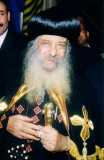
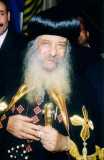
Fitzgerald: The Coptic Pope is held hostage.
The Coptic Pope -- the one held hostage by the Muslims of Egypt, subject to their pressures, aware of the potential for mayhem and murder visited upon the Copts by Muslims at any time -- has denounced the Pope of Rome. We understand this. We understand that he is held hostage, and we dismiss these remarks even as we now dismiss the Michel Sabbaghs and Naim Ateeks and other "Palestinian" islamochristians who speak out of internalized fear, and also in some cases out of a misplaced identification of "Uruba" or "Arabness" with Islam. (That is an identification that Muslim Arabs insist on forcing on everyone who uses Arabic, and only the Maronites and the Copts, and not even all of them, have refused to fall for this aggrandizing and false definition of "Arab").
But here's the point. What if the world remains too fearful and confused ever to confront the truth? After all, those whose duty it is to instruct us remain unable to instruct us out of the fear and confusion from which Pope Shenouda is suffering. Or, still worse, they remain silent out of a diseased sympathy for Muslims, a belief that we should not tell the truth about Islam but try only to "win hearts and minds" of Muslims by lying to ourselves, as well as to them, about the nature of Islam. Yet the evidence is not only in the texts, not only in the 1350 years of Jihad-conquest and subjugation of non-Muslims, but in the behavior of Muslims, mobs and rulers, clerics and generals and political figures and so-called "intellectuals" alike, all over the world. (Click on the title to read the rest of the article.)
Subscribe to:
Posts (Atom)